
Why Restaurants Need to Own their Social Proof
4 Min Read By MRM Staff
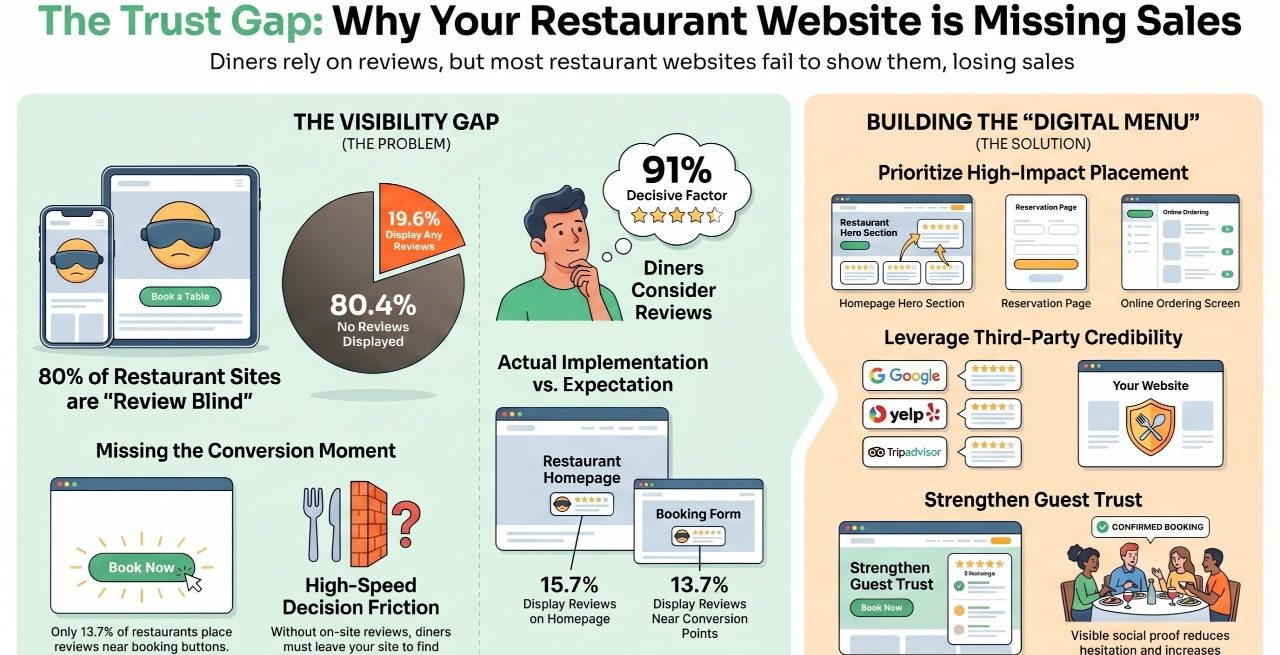
Restaurant operators need to treat reviews as decision-support assets in order to reduce friction and build guest trust, according to ReputationRiser’s Restaurant Website Review Visibility Analysis. A review of 51 restaurant websites found that more than 80 percent fail to display third-party customer reviews on their own site.
The data is part of the company’s larger Customer Review Trust Study, an analysis of 1,000 U.S. small business websites that found 72 percent fail to display customer reviews prominently on their sites.
“Restaurants are missing the opportunity to reinforce trust at the exact moment a guest is deciding whether to book, order, call, or keep browsing,” explained Tim Sumer, founder of ReputationRiser.
While most restaurants already have reviews on Google, Yelp, TripAdvisor, OpenTable, delivery apps, or other third-party platforms, if those reviews are not visible on the restaurant’s own website, the operator is relying on guests to leave the site and find that proof somewhere else and this causes unnecessary friction, he added.
“A restaurant website already has key decision points: the menu, reservation button, online ordering link, catering inquiry form, private dining page, or location page. Reviews can help support those decisions directly. When they are absent, the website has to work harder to build confidence.”
Social Proof Management
Among the key findings:
• 19.6 percent of restaurant websites reviewed displayed testimonials or reviews anywhere on the site
• 15.7 percent displayed reviews on the homepage
• 13.7 percent displayed reviews near forms, booking buttons, or other conversion points
That suggests many restaurants are earning social proof, but not using it where it can influence guest action, Sumer said, adding that one of the biggest reasons is that reviews are usually treated as something that lives on third-party platforms, not as part of the restaurant’s website strategy.
“Restaurant operators are already focused on operations, staffing, menus, reservations, ordering platforms, and customer experience. Updating a website every time a strong new review comes in is not usually something they have the time or bandwidth to manage manually.”
There is also a practical gap between collecting reviews and displaying them, Sumer pointed out. A restaurant may have strong Google reviews, but unless there is a simple process for bringing those reviews onto the website, they often stay disconnected from the site experience.
“That is one reason automated review display can be useful. If a restaurant can surface recent, positive feedback on its website without manually updating the page every time, reviews become much easier to use as an ongoing trust signal.”
Decision-Support Assets
The data suggests operators should view reviews as decision-support assets for guests.
“A review is not just a reputation marker,” said Sumer. “It can actively support the decision to reserve a table, place an order, submit a catering inquiry, or choose one restaurant over another. The strongest reviews tend to be recent, specific, and relevant to the decision the guest is making.”
For example, someone looking at a private dining page may be reassured by a review mentioning a great event experience, he suggested. Someone considering online ordering may be influenced by a review that mentions consistent food quality or fast service. Someone choosing between two similar restaurants may feel more confident selecting the one that shows visible proof from real guests.
“That is why I call reviews decision-support assets,” said Sumer. “They help reduce uncertainty at the point where the guest is closest to taking action. The more closely the review matches what the guest is considering, the more helpful it becomes.”
Effective Review Qualities
Recency matters because guests want to know what the restaurant experience is like now, not just what it was like years ago, he said, noting that a great review from last week often feels more persuasive than a great review from several years ago.
Specificity also matters. A review that mentions the food, service, atmosphere, speed, consistency, special occasions, private events, or online ordering experience gives potential guests more useful information than generic praise alone, Sumer said.
Relevance matters, too, he said. A review about a great private event belongs on a private dining page. A review about fast service or consistent food quality can support online ordering. A review about atmosphere or hospitality can work well near a reservation prompt.
Strategic Placement for Reviews
The homepage is one of the best places to display reviews because it is often the first impression, Sumer said. If a guest lands there and quickly sees credible customer feedback, it helps establish trust early.
Reservation pages and booking areas are also important because that is where guests are closest to taking action. A review near a reservation button can help reduce hesitation.
Online ordering pages are another strong placement because guests are deciding whether they trust the restaurant enough to order food directly. Catering and private dining pages are especially important because those are higher-value decisions. Guests planning an event often need more reassurance than someone browsing a regular menu.
Location pages can also benefit from reviews, especially for restaurants with multiple locations. Location-specific feedback helps guests feel more confident about the exact restaurant they are considering.
“The broader point is that reviews should not be hidden on a separate testimonials page that few people visit,” said Sumer. “They should be visible throughout the website experience, especially near the points where guests are deciding whether to book, order, call, or inquire.”
Think Practical First
Guests usually want to view practical information first on a restaurant website.
“They want to see the menu, hours, location, photos, reservation options, online ordering, parking details if relevant, and a clear sense of what the experience will be like,” said Sumer. “But they also want reassurance.”
He said a restaurant website should answer two questions quickly:
Can I get the information I need?
And does this place feel worth choosing?
“That second question is where reviews matter,” Sumer said. “Photos and menus help create interest, but reviews help validate the choice. Guests want to know that other people had a good experience, that the food is consistent, and that the service and atmosphere match what the restaurant is presenting.”