
The ‘Little to No Breathing Room’ Reality for Restaurants
3 Min Read By MRM Staff
Many restaurants are profitable in theory, but cash-constrained in reality because, while they are generating revenue, that money is immediately reinvested in day-to-day operations, according to a new study by Clarify Capital.
In fact, fifty-one percent of restaurant owners have gone without a paycheck in the past year to make payroll, while 90 percent are borrowing or seeking financing this year, the research found.
“There’s little to no breathing room,” Michael Baynes, CEO & Co-founder of Clarify Capital, told Modern Restaurant Management (MRM) magazine. “Your business on paper can be profitable, but still feel like it’s getting squeezed out of profits most of the month. Money is constantly back into your restaurant, whether it’s payroll, food orders, rent, repairs, or vendor payments.”
The Profitability Trap
Clarify Capital analyzed Bureau of Labor Statistics wage data from 2019 through 2026, Zillow rent data, and surveyed 391 restaurant owners across the U.S. to better understand the financial realities facing restaurants today.
Other key findings:
-
Restaurant hourly wages have grown 47 percent since 2019, outpacing overall private-sector wage growth by 12 percentage points.
-
Sixty percent rank labor costs among their top two sources of margin pressure.
-
Forty-four percent rank staffing and retention among their top two investment priorities for 2026, while 41 percent say labor availability is one of their biggest growth challenges.
-
More than two in five (41 percent) have considered selling their restaurant in the past year because the stress no longer feels worth the margin.
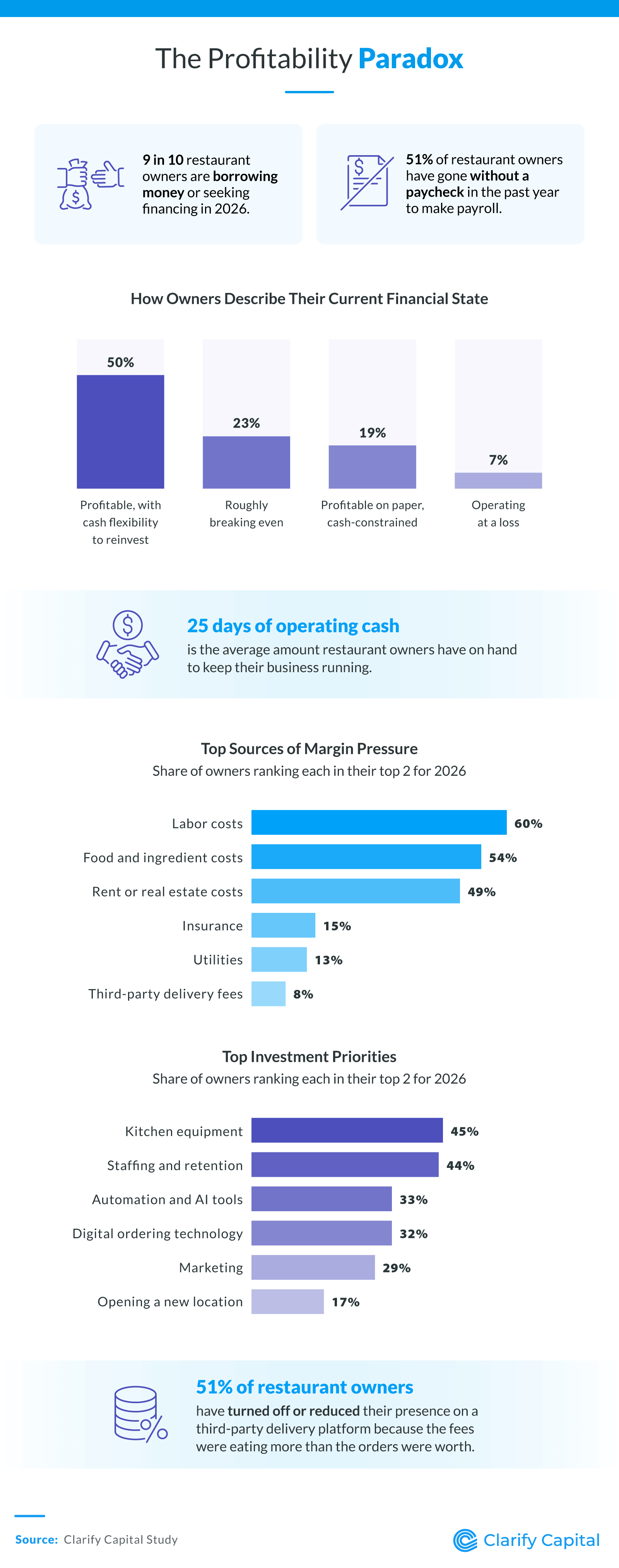
Image courtesy of Clarify Capital
Rethinking Financial Strategy
Restaurants have been hit from multiple directions at once, Baynes explained with 56 percent of operators reporting that food and supply expenses are hindering their growth.
“You have the costs of living and inflation on the rise, as well as food costs and even transportation costs that are all putting pressure on restaurant margins. So, profitability in 2026 requires far more revenue than it did previously.”
Revenue isn’t the best measure of financial wellbeing anymore, the findings suggest. Operators need to pay close attention to cash flow, reserves, and cost management as they do their sales growth.
“If you stay aligned with these fundamentals, you’ll be in a more sustainable position when the market conditions change,” Baynes said. The biggest risk is that owners lose the ability to absorb surprises. When cash reserves are thin, all it takes is one equipment failure, one slow season, or some surprise expense to create a serious long-term problem.”
Financial realities are making operators reevaluate their delivery programs and partnerships. More than half of operators reported turning off or reducing third-party delivery platforms due to the fees not making it worthwhile, suggesting the current economics aren't working for a large segment of independent restaurants, who are already facing more challenges, Baynes added.
“While sure, delivery platforms offer up a greater reach and convenience, if the fees are always chipping away at already thin margins, it tracks that operators are going to be looking for alternatives. Long term, the most sustainable model is one where both parties can profit from each transaction.”
If an operator is constantly in survival mode, that’s also a recipe for additional burnout, can cause tension, and make it harder to invest in restaurant growth, Baynes said. Additionally, the data found that a majority of owners said their most profitable month was also their most stressful.
“That speaks volumes to how disconnected sales and financial stability have become. Just because you’re pulling in more revenue doesn’t mean there’s less pressure, and to a lot of people outside of the industry, they might not see or expect that.”
Looking Ahead: Resilience in the Face of Burnout
Despite the disconcerting findings, 75 percent of respondents still expect to be in business in the foreseeable future.
“Restaurant owners really are just built differently, and are some of the most resilient entrepreneurs that exist,” Baynes said. “They’re operating in a field where long hours, thin margins, and constant operational challenges are expected, yet they keep showing up because they’re passionate about what they’ve created. The fact that so many see themselves still being in business years from now speaks to their persistence and determination, and that’s pretty hard to find in a lot of other industries.”
What will separate restaurants who survive the next few years from those who don't?
Looking ahead, financial flexibility will be just as valuable as having a great menu and Yelp reviews, Baynes predicted.
“Being the busiest restaurant won’t ensure your survival. The restaurants that manage their cash flow well, stay on top of expenses, embrace efficiency, and adapt quickly when consumer behavior shifts…those are going to be ones that survive."