
The Hidden Cost of Restaurant Turnover and How to Stop the Revolving Door
6 Min Read By Mary Fabro
With turnover rates exceeding 75 percent and replacement costs topping $5,800 per employee, according to Cornell University research, staff churn remains one of the most destructive and underestimated drains on restaurant profitability. Here's what the data says, and what operators can do about it.
Every restaurant owner knows the feeling: a reliable server puts in their two weeks' notice, a line cook doesn't show up for their shift, a trusted manager takes a call from a competitor. The cycle of hiring, training, and losing staff has long been accepted as a fact of life in the restaurant industry. But in 2026, accepting that status quo has a price tag and it's one most operators can't afford to ignore.
The numbers are stark. According to the 2026 State of Restaurants Report from TouchBistro, 96 percent of operators say they are spending more on labor costs this year compared to last. Meanwhile, industry-wide employee turnover rates continue to exceed 75 percent, with quick-service segments seeing rates that can surpass 150 percent. At a cost of roughly $5,864 per employee replaced, the math adds up fast and for a mid-size restaurant, unchecked turnover can quietly consume well over $100,000 per year.
The good news? Turnover is not entirely inevitable. Understanding what's driving it and investing in the right countermeasures is one of the highest-ROI moves an operator can make in a year defined by squeezed margins.
By the Numbers: What Turnover Is Actually Costing You
The Center for Hospitality Research at Cornell University estimates the cost of replacing a single front-line restaurant employee at $5,864. That figure covers separation costs, the time spent recruiting and interviewing, onboarding administration, and formal training which alone accounts for roughly $821 per hire.
But direct costs tell only part of the story. When a server or line cook walks out the door, the hidden costs compound quickly:
• Lost productivity: An employee's output typically declines in the weeks before they resign, long before anyone knows they're leaving.
• Overworked remaining staff: Colleagues who pick up the slack face burnout, which accelerates their own departure.
• Service degradation: Newer, less-experienced staff take longer to master the menu, your service style, and guest expectations costing you in reviews and repeat visits.
• Manager time drain: Your best managers spend hours advertising roles, screening candidates, and conducting training instead of running the floor.
A 50-employee restaurant running at 70 percent annual turnover can see the invisible costs of staff churn exceed $205,000 per year, most of it never appearing as a single line item on any P&L.
A survey of 511 U.S. restaurant operators conducted by 7shifts in early 2025 found that staff turnover ranked among the top three concerns for 36 percent of respondents. And the 2026 State of Restaurants Report notes that the average restaurant is currently short five team members, up from 3.8 in 2024, with 80 percent of restaurants reporting at least one open position.
Why People Are Really Leaving
Before you can fix the revolving door, you need to understand who's pushing it open. The data points to a cluster of interconnected factors:
Pay is the most frequently cited reason. According to the 2026 State of Restaurants Report, 44 percent of departing employees leave in search of a higher hourly wage. With minimum wages rising across 22 states this year and competitive pressure coming from every direction, restaurants that don't revisit their compensation regularly are continuously recruiting for their competitors.
Scheduling instability is a close second. Unpredictable, last-minute, or inequitable scheduling creates financial anxiety for hourly workers and erodes trust in management. For employees living paycheck to paycheck, a chaotic schedule isn't just inconvenient, it's a dealbreaker.
Lack of growth opportunity is the slow burn. Mid-tenure employees, those who have been with you long enough to be genuinely valuable, are disproportionately likely to leave for roles with a clearer career path. When there's no mentorship, no cross-training, and no roadmap beyond their current position, your best people start looking elsewhere.
Management and culture problems are the variables most operators underestimate. Poor communication, inconsistent recognition, and a toxic or chaotic work environment push people out even when pay and scheduling are adequate. Employees don't just leave jobs, they leave managers.
Five Strategies That Move the Needle
The following approaches are grounded in what operators are actually doing to improve retention in 2026's difficult environment. Not theory, but tactical moves with documented results.
1. Get Serious About Competitive Compensation
The instinct to minimize labor costs is understandable, but chronically underinvesting in wages creates a far more expensive cycle of constant turnover. Audit what nearby restaurants and hospitality businesses are paying, and benchmark your rates at or above the midpoint for your market. Fair tip-sharing structures matter too. Front-of-house staff at restaurants with transparent, equitable tip policies report higher job satisfaction and longer average tenures.
Earned wage access (EWA) is also gaining traction. Programs that allow employees to access earned pay before payday reduce the financial stress that drives workers to seek higher-paying roles elsewhere. According to a Harris Poll commissioned by DailyPay, 98 percent of restaurants offering EWA report a positive impact on retention.
2. Build a Smarter Scheduling System
Scheduling based on gut instinct is one of the fastest ways to both overspend on labor and frustrate your team. Modern workforce scheduling tools use historical sales data and traffic patterns to match staffing to actual demand keeping you neither overstaffed nor understaffed. Staggered start times and peak-period coverage reduce idle labor costs while ensuring service coverage when it matters most.
Giving employees some control over their schedules, the ability to mark availability, swap shifts, or pick up open hours through an app, dramatically reduces last-minute call-outs and builds goodwill. According to the 2026 State of Restaurants Report, 34 percent of operators have already adopted cross-training and flexible staffing approaches to control labor costs.
3. Create Visible Career Pathways
Turnover among long-tenured employees is particularly damaging because it takes their institutional knowledge and guest relationships with them. The antidote is a clearly communicated growth structure. Even in a 20-person operation, you can designate lead roles, run cross-training programs, and regularly discuss advancement goals with promising team members.
Cross-training serves a dual purpose: it gives employees new skills and a reason to stay, while giving you operational flexibility to absorb spikes without adding headcount. One well-trained, multi-role employee often replaces two narrowly trained ones on the schedule.
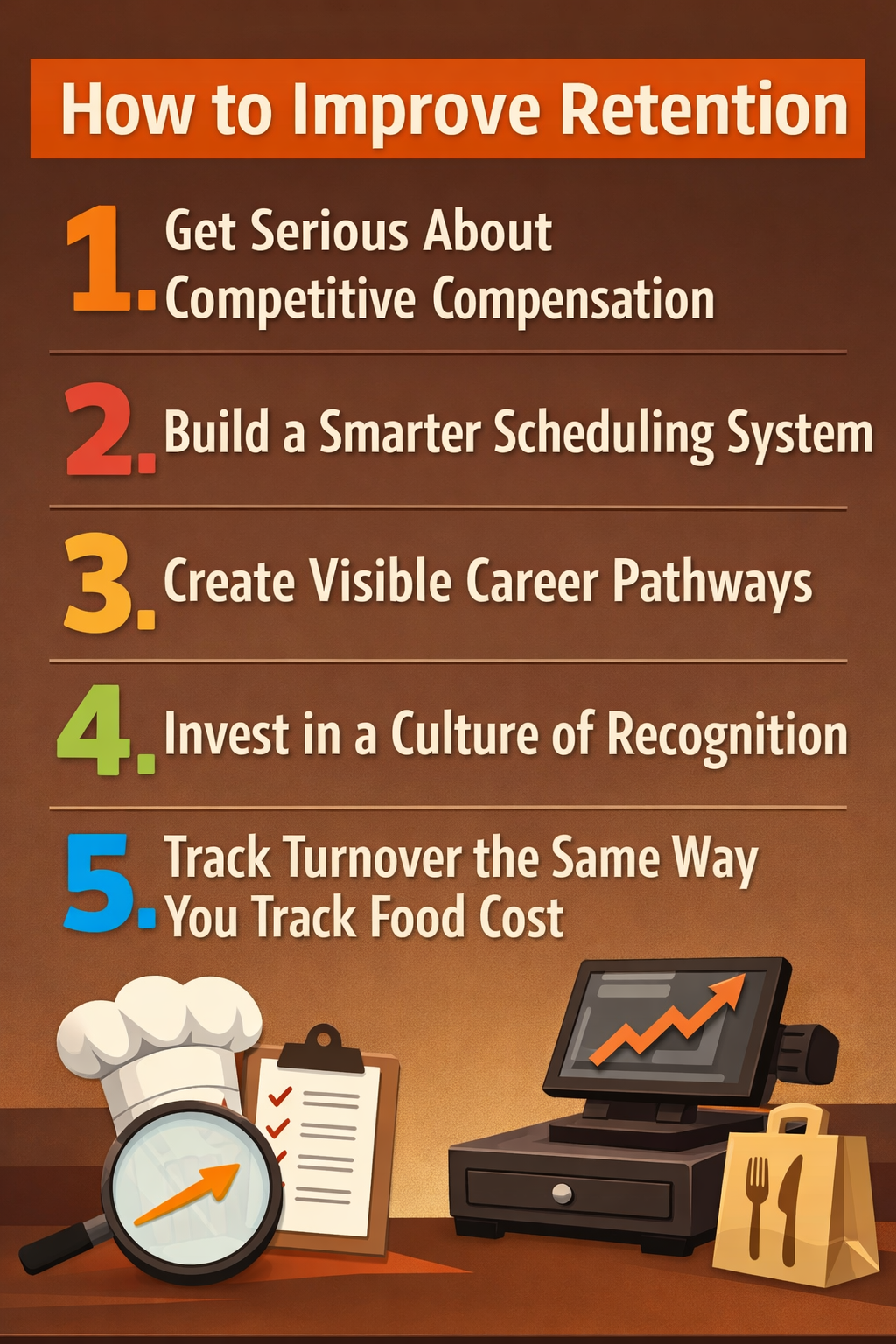
4. Invest in a Culture of Recognition
Recognition programs don't require a large budget. A consistent, genuine practice of acknowledging contributions in team meetings, in one-on-one check-ins, in writing, has measurable effects on retention. When employees feel seen and valued, their attachment to the workplace increases. When they don't, they start answering job alerts.
Conduct exit interviews whenever possible, and take the feedback seriously. If three departing employees in a row cite the same supervisor or the same scheduling issue, that's a signal, not a coincidence. The data from your own revolving door is one of the best retention tools you have.
5. Track Turnover the Same Way You Track Food Cost
Most operators monitor food cost percentage every week. Very few apply the same rigor to labor turnover. Calculating your monthly turnover rate (number of separations divided by average headcount, multiplied by 100) gives you a baseline and lets you spot trends before they become expensive crises.
If your rate is trending upward, that's a trigger to investigate: Are call-outs increasing? Is scheduling particularly chaotic in one station? Did a new manager start three months ago? Weekly visibility into labor performance enabled by modern POS and workforce management platforms means you're adjusting before payroll is processed, not after.
The Bigger Picture: Labor as Strategic Investment
The National Restaurant Association's 2026 State of the Restaurant Industry report projects that total restaurant and foodservice sales will reach $1.55 trillion this year, with employment growing to 15.8 million jobs. The industry is not shrinking but it is getting more competitive, and the operators who will take market share are those who treat their workforce as a strategic asset rather than a variable cost to minimize.
Nearly three quarters of operators plan to hire this year, but expect difficulty finding experienced managers and chefs. That scarcity makes retention an even sharper competitive advantage. Every employee you keep is one your competition has to recruit, train, and pay to replace.
The operators who will define the next generation of successful restaurants are those who invest in their people the way they invest in their kitchens with discipline, data, and a long-term view.
Labor control isn't about squeezing staff. It's about running a smarter operation that works for both guests and your team. In a year when 42 percent of operators reported their restaurant was not profitable, reducing unnecessary turnover isn't a nice-to-have, it's one of the most direct paths back to the black.
The revolving door can be slowed. It starts with treating every departure not as an inevitability, but as a data point and committing to building an operation where good people want to stay.