
How Cultural Crossroads Are Reshaping Global Hospitality
6 Min Read By MRM Staff
Worldwide hospitality is undergoing a transformation driven by shifting consumer values, sustainability expectations, cultural storytelling, and technological advancement. Diners are demanding experiences that feel more authentic, rooted in narrative, and value-aligned, according to “Redefining Global Hospitality: The cultural crossroads of the US & UK,” a whitepaper from Harrison that identifies seven areas operators should address to future-proof their businesses: personalization, sustainability, storytelling, service, brand alignment, innovation, and cultural awareness.
Among the key findings:
-
While 78 percent of UK diners now rank food quality above cost, US consumers are rapidly closing the gap, with demand for organic and non-GMO options up 18 percent in five years.
-
Fine-dining techniques, philosophy and innovation-led creativity are filtering into everyday menus with respect for ingredients reshaping even the most casual dining formats.
-
Dining has become a storytelling medium, one that drives both loyalty and spend. Restaurants embedding narrative into their experience see a 22-percent uplift in average check size.
-
Blockchain is evolving from buzzword to business tool.
-
When a brand’s ambience, menu and mission are aligned, it transcends dining to become culture.
-
The service experience is becoming the new brand signature.
-
Hospitality is fragmenting from immersive gaming venues to zero-waste kitchens, but the winner’s share a consistent formula: community, creativity, and connection.
“Hospitality is undergoing a cultural reset and is at a pivotal moment,” said Sarah Jenkinson, Creative Director at Harrison and author of the global whitepaper. “Boundaries which once defined the industry are dissolving, priorities changing, and bold contemporary brands are emerging as industry icons and powerhouses. Where once location and price dictated choice, we’re now seeing emotional connection and shared values take the lead. Brands that understand local nuance and balance it with global inspiration are the ones setting the new benchmark.”
For a deeper dive into the data, Modern Restaurant Management (MRM) magazine reached out to Jenkinson.
What do you hope operators take away from the report?
That it’s time to zoom out and stop looking at metrics in isolation. Marketing, operations, design, and culture need to be connected.
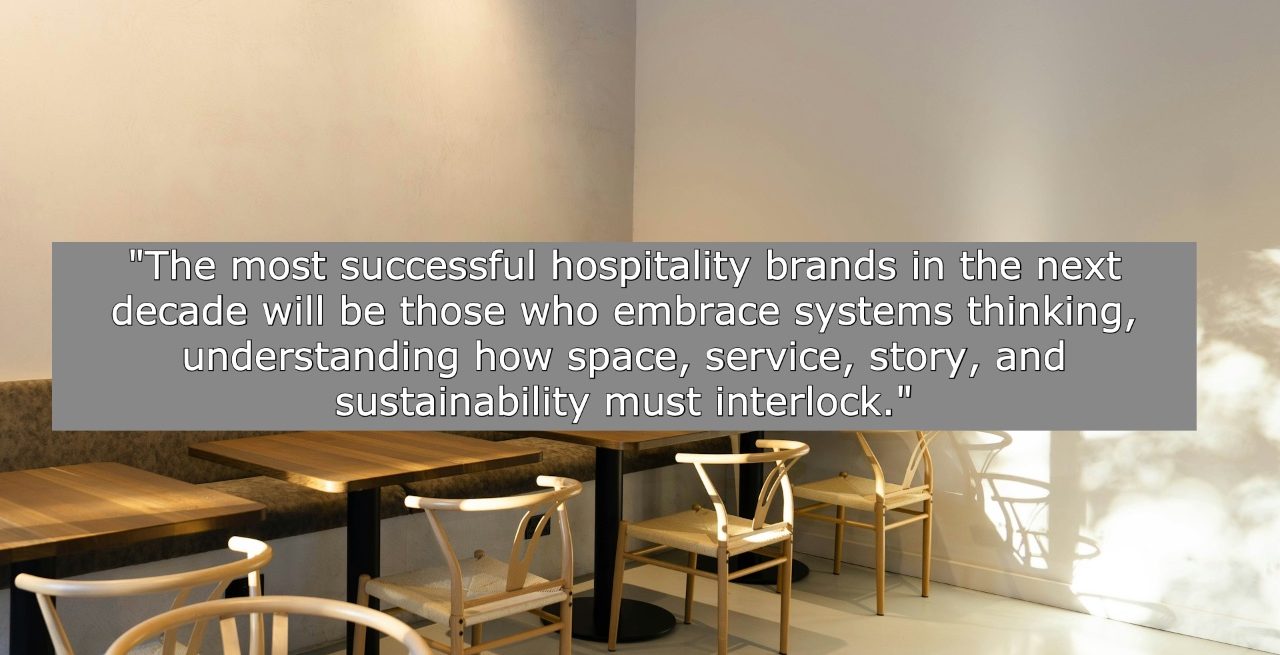
The most successful hospitality brands in the next decade will be those who embrace systems thinking, understanding how space, service, story, and sustainability must interlock. It’s not about chasing every trend. Rather, it’s about crafting concepts with soul, scale, and staying power.
In what ways should operators be thinking bigger and acting bolder and why is it important?
Hospitality brands are becoming lifestyle brands. They are becoming content creators, wellness advocates, sustainability leaders. The question isn’t “what’s trending?” it’s “what’s possible?” Acting boldly means prototyping ideas faster, breaking traditional rules, and being relentlessly guest-centric.
Acting boldly means prototyping ideas faster, breaking traditional rules, and being relentlessly guest-centric.
What are key similarities and differences in the US and UK hospitality markets and guests?
Both markets are seeing a convergence around the importance of experience. Guests want more than just a meal. They want connection, immersion, and storytelling. But the US tends to move at a faster pace, with greater emphasis on scalability and franchising, while the UK often puts more weight on heritage and craft. In the US, we also see bolder experimentation and a stronger fusion of wellness, tech, and hospitality, especially post-pandemic.
In the US, regionality plays a huge role. In Texas, hospitality is emphasized. On the West Coast, wellness is a major focus. On the East Coast, heritage is key. They all behave like entirely different markets. The UK is more unified but deeply shaped by local provenance and tradition.
How and why are people changing the ways they engage with food?
People are eating more intentionally and craving food that makes them feel better physiologically and emotionally.
Food is a ritual, nourishment, and reassurance.
There’s a deepening focus on wellness, sustainability, and emotional connection to food. Dining is increasingly viewed as an act of self-care, a way to express values, or support a cause. We’re seeing guests explore plant-forward options, global flavors, and dining environments that feel restorative.
Food is a medium for storytelling now, not just sustenance. Food is a ritual, nourishment, and reassurance.
What are the best things restaurant operators can do to future-proof their businesses? What are some examples of operators who excelling in future-proofing their restaurants?
Future-proofing means building flexibility into your brand’s DNA: adaptable formats, multifunctional spaces, and a clear purpose. Operators like Fogo de Chão, Sweetgreen, and Ramsay’s Kitchen are investing in technology, but they’re also designing around emotional resonance. They’re creating frictionless yet immersive journeys, balancing efficiency with human touch. The operators who win are designing for resilience, spaces that flex between daypart, guest type, and even economic climate.
What can an aspiring restaurateur learn from this report about creating a concept and designing a space that has a chance of connecting with guests?
Start with your “why.” Don’t chase aesthetics. Build around an idea that matters to you and your intended guests. Design should extend the brand’s essence. Great spaces choreograph emotion. That includes how guests feel walking in, interacting with staff, and choosing their meal. It’s about resonance, not just appearance.
What are the best ways for restaurant operators to relate their values such as commitment to sustainable practices to potential guests in their menus and their marketing, while still being authentic?
It starts with doing the work behind the scenes—local sourcing, waste reduction, conscious materials—and then telling that story with clarity and humility. Menus can spotlight ingredients with origin stories. Design can reflect circularity.
Authenticity is earned when your values show up everywhere, not just in marketing.
Authenticity often shows up in the quiet signals — the ceramics you choose, the materials you specify, even the way staff speak about ingredients. The key is to be consistent. Authenticity is earned when your values show up everywhere, not just in marketing.
How can operators leverage data to grow, be efficient, as well as meet guest expectations for personalization?
Data is a design tool but it should never overshadow humanity. The magic happens where insight and intuition meet. When used thoughtfully, it reveals what guests value most from preferred table types to menu preferences and loyalty drivers. Mining the information is the first step, and then the real value comes from curating experiences that make guests feel seen.
How can operators tap into their unique brand stories and express them to guests?
Every brand has a soul, the deeper purpose, heritage, and ambition that set it apart in a crowded marketplace. The most successful operators take time to understand that essence and make decisions that honor it, from the way they welcome guests to the materials, menu, and atmosphere they create.
Every brand has a soul, the deeper purpose, heritage, and ambition that set it apart in a crowded marketplace.
Your team must know the story first. They’re the storytellers long before the design or the menu comes to life.
When the people behind the brand truly understand what it stands for, they naturally become the storytellers. That clarity makes it easier to express who you are in ways guests can feel, not through volume, but through authenticity.
At Harrison, we help bring that story to life through multisensory experiences that feel unmistakably “them.” It’s not about adding noise; it’s about amplifying what already makes a brand unique so it resonates deeply and memorably with guests.
In what ways are fine dining techniques influencing casual dining?
There’s a trickle-down of craft. Casual brands are borrowing techniques and elements like open kitchens, chef-facing experiences, chef-led menus, and curated plating, but making them more approachable and transparent. It’s not about exclusivity anymore; it’s about access to quality. That blurring of boundaries is giving rise to a new category: elevated casual.
What do restaurant operators need to understand about blockchain and its use in hospitality?
Blockchain isn’t just a tech buzzword; it is a tool for trust. One of its biggest opportunities is the ability to verify provenance. Imagine being able to trace the exact journey of a cut of Wagyu, or understand the farm, feed, and care behind the meat you are eating. In California, early blockchain pilots are already being used to track premium beef with remarkable accuracy, reducing inefficiencies and giving guests real confidence in what is on their plate.
Blockchain is not about replacing story; it is about reinforcing it with trust.
This level of transparency aligns closely with European expectations, where food systems tend to be less industrialized, less processed, and more regulated around quality. Guests in the UK are accustomed to clear standards and certifications, and they want to know their food is healthy, responsibly sourced, and minimally touched by unnecessary additives.
Blockchain brings that mindset into the US market at scale. It allows operators to offer something powerful: clarity. Not marketing language, not assumptions, but verified truth. In a world where guests care deeply about wellness, sustainability, and what they put into their bodies, that truth becomes a competitive advantage. Blockchain is not about replacing story; it is about reinforcing it with trust.
Based on this report, what do you think restaurants of the future say five to ten years from now will look like? How do you anticipate tipping and service models will evolve?
We’ll see more hybrid spaces: part café, part retail, part community hub. Service models will evolve to reflect changing labor dynamics and guest expectations. Some will eliminate tipping, others will adopt transparent service charges. What will remain constant is the need for emotional intelligence: creating moments of care, delight, and meaning. The future belongs to brands that understand both head and heart, strategy and soul. When you design for emotional connection, you build something that lasts.