
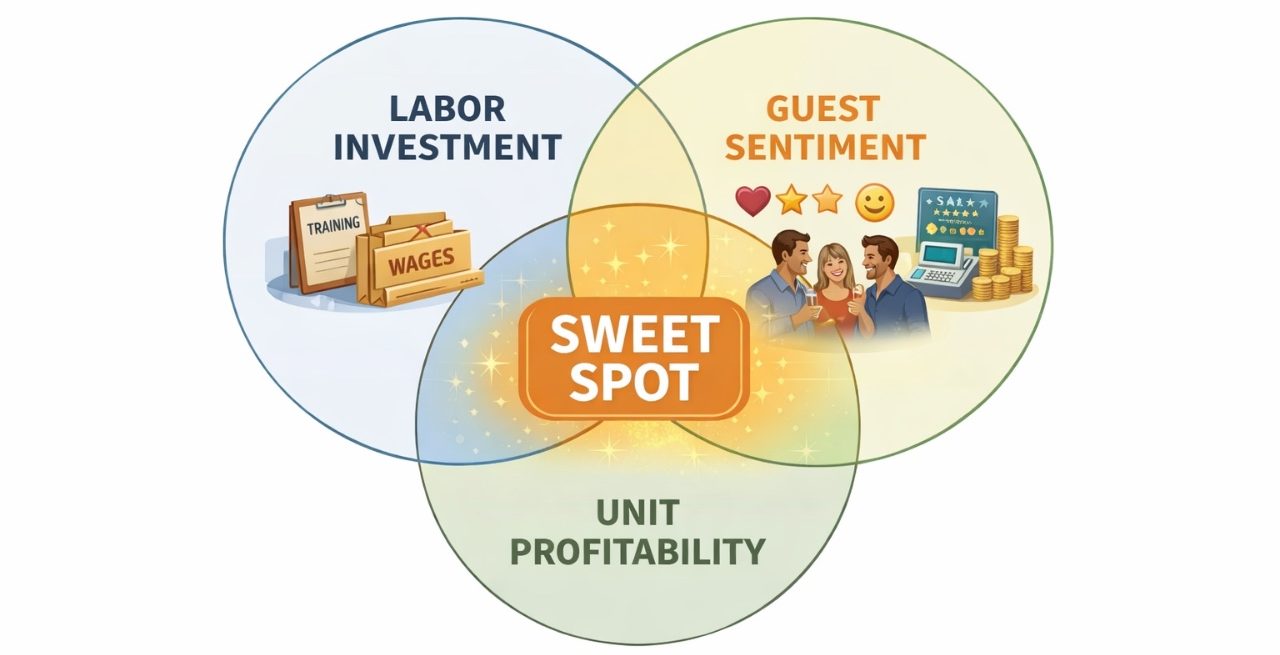
Finding the Operational ‘Sweet Spot’
3 Min Read By MRM Staff
Strategic investment in well-trained, engaged restaurant teams is directly proven to boost guest satisfaction and sales, according to a joint study from Revenue Management Solutions and Merchant Centric, that uncovered an operational “sweet spot” where labor investment, guest sentiment and unit profitability align.
“For years, restaurant brands have looked at financial performance and guest sentiment separately, which makes it hard to see what’s really driving results,” said Revenue Management Solutions (RMS) CEO John Oakes. “What this report shows is the performance improvement that happens when you connect those dots, linking review sentiment with comp sales, labor benchmarks and other unit-level economics.”
By bringing together RMS’s metiRi® data and Merchant Centric’s sentiment analytics, brands can actually see how staffing and operational decisions show up in the guest experience and ultimately in the bottom line.
“The big takeaway is that connected data isn’t just a technology upgrade; it’s an operational advantage that leads to better decisions,” Oakes added.
Among the key findings:
-
Restaurants that invest in well-trained, low-turnover teams consistently earn higher customer review scores and Net Promoter Scores (NPS). The key is spending smarter on the right mix of staffing and training, not simply to spend more.
-
Across brands, locations with consistently positive feedback on staff demeanor and dedication significantly outperform their peers on review scores and NPS.
-
Restaurants with improved customer reviews and NPS demonstrate measurably stronger sales performance, proving the direct revenue impact of positive guest experiences.
“The ‘sweet spot’ really isn’t about spending more on labor – it’s about spending it effectively, explained Merchant Centric CEO David Bay. “Operators can start by benchmarking locations against their own top performers or similar competitors, looking at where comp sales and guest ratings are strongest and then comparing labor-to-sales ratios and turnover.”
What the analysis makes clear is that well-trained, stable teams consistently deliver higher review scores, NPS and sales, he said. Tools like RMS’s metiRi let operators see those comparisons at the unit level, so they can identify where labor investment is under- or over-weighted and where changes will have the biggest impact.
Quantifying What Operators Have Long Suspected
The data reinforces what most operators already sense: when you retain high-performing staff, labor costs tend to align better with sales, and you avoid the ongoing recruiting and training expense, Oakes noted. Locations with low-turnover teams run more efficiently from a labor-to-sales standpoint and also deliver better guest experiences, which are reflected in stronger reviews, higher NPS and better comp sales.
“So the takeaway is that retention isn’t just an HR issue; it’s a measurable driver of financial and brand performance,” said Oakes. “Investing in retention-focused staffing strategies should be viewed as core to operations.”
Another insight is that the study gives operators data to prove what they always suspected. With high labor costs and turnover a constant challenge, they can now measure how staffing decisions affect profit.
“Many of the relationships the data shows are intuitive, but what’s powerful is finally being able to quantify them,” said Bay. “Operators have always relied on experience and instinct to manage labor and guest experience. Now they can actually measure how staffing strategy, training and retention affect satisfaction and profitability. That’s especially important right now, with record labor costs and persistent turnover, when many brands still don’t have clear visibility into how decisions ripple across performance.”
Beyond Staffing: Other Operational Levers
While staffing remains critical, the analysis also points to additional operational levers that influence sales and guest experience.
“Guest engagement remains foundational,” Oakes said. “Sentiment around staff demeanor and dedication tends to correlate with other operational drivers like timeliness, order accuracy and perceived value.”
Hours of operation is another often-overlooked opportunity, he said. With dining habits shifting and more off-peak demand, aligning hours to local patterns can move same-store sales. RMS analysis shows that targeted, store-level adjustments to hours, based on POS data, trade-area demand, and labor costs, have generated nearly $100 million in incremental revenue for clients, even though only 15–25 percent of locations benefit from any single change.
When optimized hours are combined with pricing strategy, menu engineering, and integrated guest-sentiment insights, operators gain clear, data-driven pathways to improve both sales performance and the guest experience, Oakes noted.