Expanding Smarter: Financing Strategies for Multi-Unit Franchise Growth
3 Min Read By Mike Yenason
As competition intensifies across QSR and fast casual segments, financing is becoming a critical tool for operators looking to scale locations, preserve liquidity, and grow sustainably.
Expansion remains one of the most effective ways franchise operators can strengthen their businesses, yet in today’s QSR and fast casual environment, growth requires more planning, more discipline, and increasingly, more strategic access to capital. Competitive segments such as chicken and beverage continue to attract new entrants, franchisors are awarding development rights selectively, and operators are balancing expansion opportunities against rising labor costs and tighter margins. As a result, growth is no longer driven solely by demand or brand momentum. It is shaped by how quickly operators can move and how effectively they structure their capital.
For many franchisees, scale delivers meaningful operational advantages. As unit counts grow, purchasing power improves, operational efficiencies begin to emerge, and franchisees often gain stronger relationships with franchisors that are looking for proven operators to support system growth. At the same time, opportunities in high-demand concepts can fill quickly, and operators who delay expansion may find fewer options available over time. This dynamic has created an environment where timing matters, and where access to capital increasingly determines who can move forward.
Capital and Speed Are Becoming Competitive Advantages
Financing plays a central role in that equation. Operators who rely exclusively on retained earnings often face slower development timelines, particularly when opportunities arise unexpectedly. Accumulating sufficient capital can take time, while attractive locations and development rights may not remain available. Financing allows operators to pursue expansion while preserving liquidity, creating flexibility to move when opportunities emerge.
Access to capital can also influence site selection decisions. When operators are constrained by available cash, they may prioritize lower cost locations that limit long-term potential. With financing, operators can evaluate stronger trade areas, consider freestanding units, or pursue locations with drive-thru capabilities that better support performance. These decisions often shape the success of a location long after construction is complete.
Speed also becomes a competitive advantage. In many markets, landlords, developers, and sellers prioritize operators who can execute quickly and demonstrate financial readiness. Being able to move forward confidently can make the difference between securing a prime location and missing an opportunity altogether. In competitive segments, this advantage compounds over time as operators build density and brand presence within their territories.
Liquidity Protects Growth
At the same time, expansion can introduce significant financial and operational demands. Opening new locations requires investments in staffing, training, and marketing before revenue stabilizes. Maintaining liquidity during this period allows operators to support new units while protecting performance at existing locations. In today’s environment, where margins remain tight and operating costs continue to evolve, preserving working capital becomes an important component of sustainable growth.
Financing structures can support this balance by spreading costs over time or providing flexibility during early ramp-up periods. Interest only periods or deferred payment structures can allow operators to allocate capital toward training, staffing, and local marketing efforts that help new locations gain traction more quickly. These operational investments often influence long term performance and help ensure consistency across expanding footprints.
Beyond construction and staffing, expansion often requires investment in technology and operational infrastructure. As operators grow, systems that support inventory management, labor scheduling, and customer engagement become increasingly important. Financing can provide flexibility to invest in these areas while maintaining liquidity for day-to-day operations.
Financing Supports Sustainable Scale
Another important consideration is operational strain. Opening multiple units simultaneously requires coordination across vendors, construction timelines, hiring, and training. Financing partners who understand franchise development can help structure deals that align with growth plans and reduce pressure during expansion. This collaboration allows operators to focus on operational execution while maintaining financial discipline.
Looking ahead, access to capital will continue to shape franchise growth. Lenders and franchisors are placing greater emphasis on proven operators with scalable infrastructure and strong performance. Multi-unit operators with disciplined growth strategies are likely to capture the majority of expansion opportunities, particularly in competitive segments.
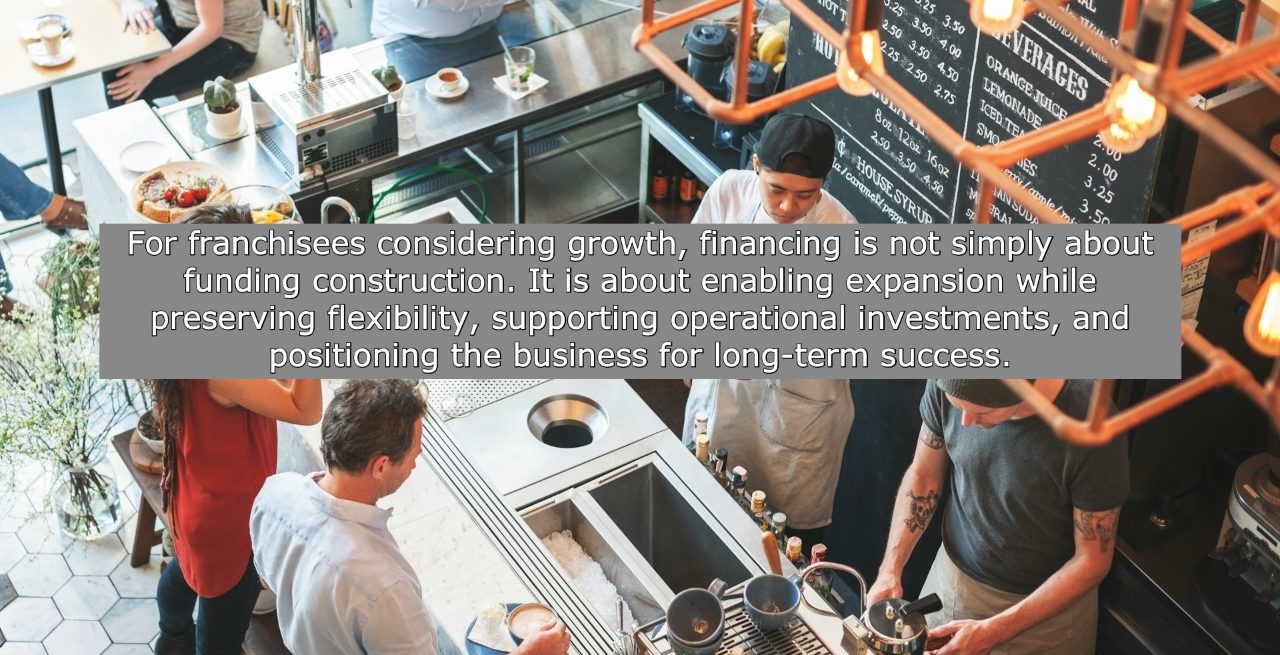
For franchisees considering growth, financing is not simply about funding construction. It is about enabling expansion while preserving flexibility, supporting operational investments, and positioning the business for long-term success. When structured thoughtfully, financing allows operators to move faster, manage risk more effectively, and scale in a way that supports sustainable growth.