
Damp January Decoded: Consumer Shifts Restaurant Operators Need to Understand
3 Min Read By MRM Staff
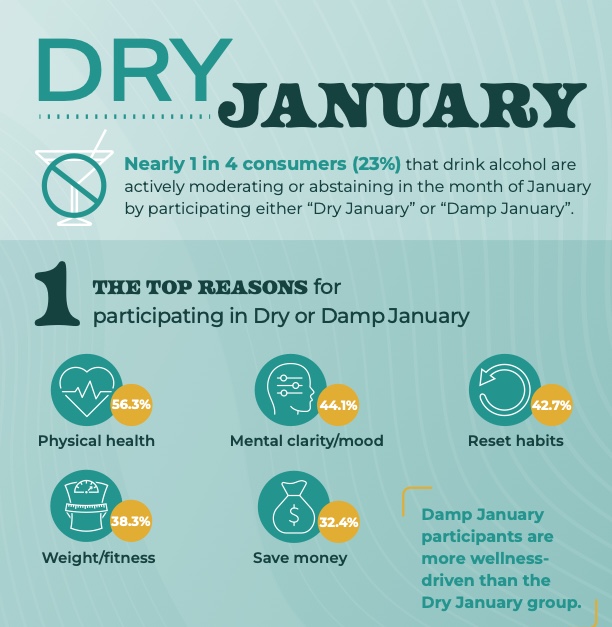
Dry January has evolved into a movement of intentional control and wellness spearheaded by the rise of "Damp January," according to a survey from Curion that found 23 percent intended to follow this trend of moderation or abstinence last month.
“Dry and Damp January are signals of a permanent shift in guest behavior, not a temporary fad,” said Katie Fellows, SVP of Strategic Insights at Curion, adding that restaurants that respond by offering high-quality, profitable, and normalized non-alcoholic (NA) options will:
-
Capture incremental beverage revenue
-
Increase guest satisfaction and inclusivity
-
Stay relevant as moderation becomes a year-round mindset
Among the key points:
-
Damp January participants are actually more wellness-driven than Dry participants A small but powerful “identity shift” segment (16 percent) is supercharging demand for sophisticated non-alcoholic spirits, wine, and mocktails.
-
Women and men participate at similar rates among drinkers, but women frame it as holistic self-care while men treat it as a rule-based reset.
-
Younger participants (18-34) are experimenting with sophisticated alternatives and maintaining social rituals (nearly 50 percent choose NA options), while older consumers (55-64) are simply cutting back (only 28.2 percent select alternatives).
“Guests don’t want fewer reasons to dine out, instead they want better options once they’re there,” said Fellows. “Dry and especially Damp January guests still want social connection, ‘drink moments’ that feel special, and menu options that signal care, quality, and intentionality.”
Operators should view non-alcoholic and low-alcohol by volume (ABV) offerings not as niche accommodations, but as menu mainstays that support evolving guest expectations around wellness, moderation, and flexibility, suggested Fellows.
“Operators can unlock strong margins while meeting guest needs by being selective and strategic. Non-alcoholic cocktails often carry equal or better margins than alcoholic drinks due to lower input costs and stable pricing while still delivering a premium experience.
She advises operators to focus on premium, intentional NA offerings and to design for substitution, not sacrifice.
-
Craft NA cocktails using house syrups, botanicals, shrubs, teas, and spices
-
Offer one-two standout NA spirits or beers rather than a long list
-
Price NA cocktails closer to alcoholic cocktails (not sodas) to reflect craftsmanship
-
Mirror classic cocktails (NA margarita, spritz, old fashioned-style)
-
Clearly mark “zero-proof” or “low-proof” versions of best sellers
-
Bundle NA drinks with prix fixe menus or happy hour pairings
Effective marketing should acknowledge choice and flexibility, not restriction and highlight the experience, Fellows said.
Use inclusive, non-judgmental language such as:
-
“Zero-proof options available”
-
“Drink your way” or “Moderation-friendly menu”
-
Avoid messaging that feels moralizing or trend-chasing
-
Feature NA cocktails visually on menus and social media
-
Call out flavor, craftsmanship, and ritual—not just “no alcohol”
-
Train servers to confidently recommend NA drinks without awkwardness
“For Dry guests, emphasize clarity, reset, and intention,” said Fellows. “For Damp guests, emphasize balance, flavor, and social enjoyment.”
Data strongly suggests this is not a January-only behavior, especially for Damp participants, she noted, offering suggestions such as baking NA and low-ABV options into the core menu and normalizing moderation, and extending into other dayparts and occasions.
Her advice to operators includes:
-
Keep at least two-to-three NA cocktails available year-round
-
Rotate seasonally to maintain interest
-
Offer half-pours or low-ABV cocktails
-
Position NA options alongside alcoholic ones—not in a separate “other” section
-
Think Lunch meetings, weekday dining, wellness-minded brunches
-
Pair NA cocktails with lighter dishes or tasting menus
Operators should think lifestyle, not trend, Fellows said.
“Guests who discover an NA option they love are likely to reorder it even when they’re not ‘doing January’.”
Curion surveyed 1,869 U.S. adults from its proprietary consumer database, asking detailed questions about alcohol consumption habits, January intentions, and alternative beverage preferences. The research was conducted in late December 2025.
