
‘Connect Your Data. Everything Else Should Follow.’
4 Min Read By MRM Staff
Restaurant operators must turn their aligned data into action in order to generate revenue and manage rising costs, according to PAR Technology’s 2026 QSR Operational Index.
“The operators pulling away from the field have connected their front-of-house ordering, their loyalty platform, and their back-of-house data into a single system that tells them what's working at every location in real time,” said Joe Yetter, President of Restaurants at PAR Technology. “That's what lets them close a $1.91 check gap worth $114,600 per store every year. Signing people up is the easy part. Making every visit worth more requires the infrastructure to act on the data.”
In order to optimize for summer and the rest of the year, Yetter suggests operators to invest in their loyalty programs because the data shows member transactions grew 32.5 percent year over year while anonymous purchases dropped 6.7 percent.
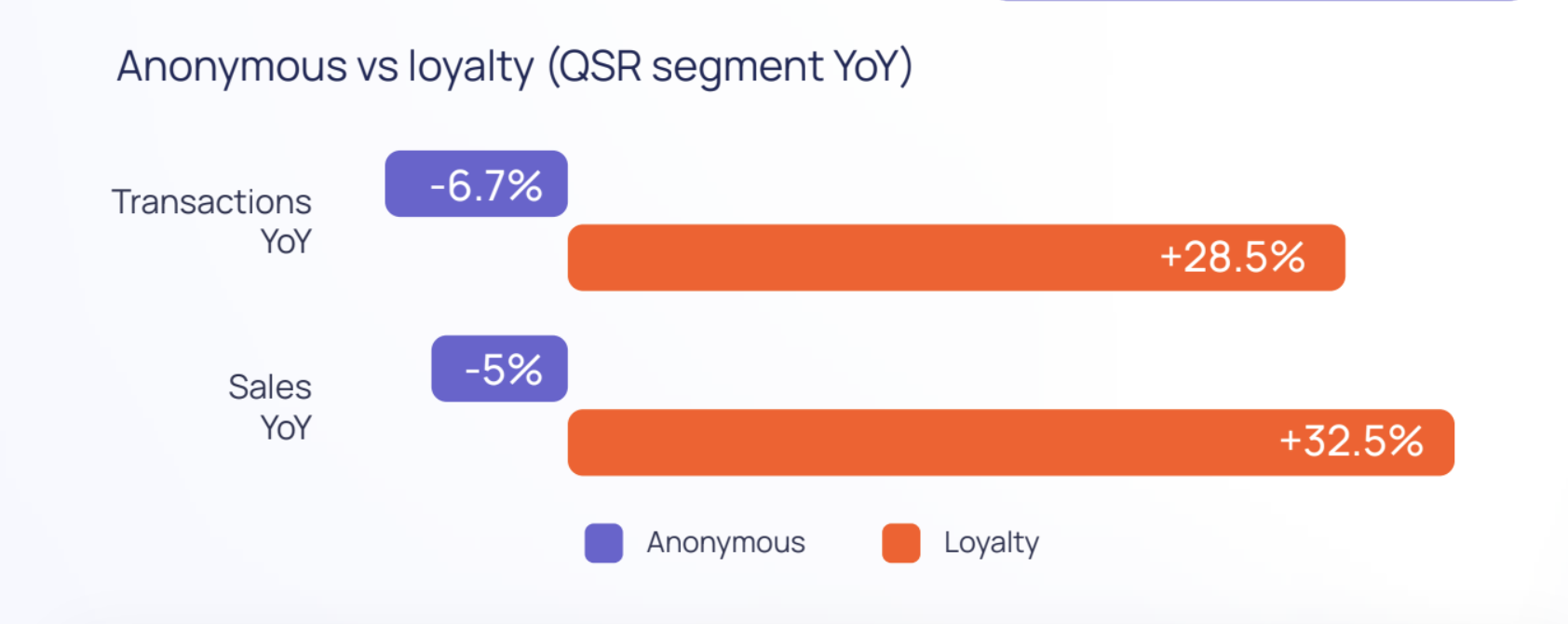
The PAR team watched that gap build, but this year it was stark with loyalty transactions going up and anonymous transactions going down, telling them that guests without a connection to a brand are actively drifting away, not just plateauing.
“That gap is not closing on its own. But loyalty isn't just a program decision. It's a technology decision. Most programs nail the signup but go quiet at exactly the wrong moment.”
The first reward is the inflection point, Yetter explained. Get guests there fast, then follow up within 30 days of redemption. When a brand does that, the data typically sees visit frequency increase by 38 percent. Programs that go silent after that first redemption leave half the lift on the table.
Beyond that, the goal isn't a bigger member base, it's converting guests into super users, the report found. Just 15 percent of members visiting 10 or more times a year account for 53 percent of loyalty sales.
“Moving a guest from casual visitor to that tier can increase their annual value by nearly 10x,” said Yetter. “That's not a marketing problem. That's an operational discipline.”
Another standout worth paying attention to is that the average check increased by 4.38 percent while customer count stayed essentially flat, Yetter noted. Growth is coming entirely from how well operators are driving value from existing guests.
“The brands that are winning right now have both: they're growing check and growing the member base. The ones that have only one of those two are managing decline, even if the revenue line looks okay for now.”
The brands that are winning right now have both: they're growing check and growing the member base. The ones that have only one of those two are managing decline, even if the revenue line looks okay for now.
The two biggest pain points for restaurants right now are labor efficiency and third-party delivery management, according to the report. Delivery brings in the biggest checks at $22.73 on average, but the bottom 10 percent of stores are losing $13.7K a year on refund discrepancies alone. Item cancellation rates quadrupled in a single year, from 0.8 percent to 3.74 percent, and they haven't come back down. A canceled delivery costs $8 more than a missed counter order.
“In a traffic-light environment, revenue is gone for good,” Yetter said. “Most operators don't know which stores are the problem until the month is over. By then, the money is lost. Connect your data. Everything else should follow. The operators closing that gap have built cross-system visibility — real-time data flowing from the third-party platform into the same place they're watching labor, inventory, and guest satisfaction.”
Yetter advises operators to fix the infrastructure and the delivery performance should follow.
“Longer-term, the brands that own their customer data and have direct relationships with guests will have a real edge. The delivery apps are a channel, not a strategy.”
The operators closing check gaps aren't buying traffic with value menus, they're building upsell into the ordering flow, the report revealed.
“Discounting is the laziest lever in the industry,” said Yetter. “Kiosks are growing 35 percent year over year, but checks are running $1.25 below counter. That's not a kiosk problem. That's a front-of-house technology problem.”
The same customer who gets asked at the counter whether they want a drink will skip that step entirely on a kiosk that doesn't ask, but AI-powered upsell built into the ordering flow fixes that because it makes the prompt automatic, consistent, and personalized to what that guest is likely to order next without a crew member having to remember it, Yetter said.
“That's front-of-house technology doing what it's supposed to do. The same thinking applies to delivery, where guests are already spending 58 to 80 percent more per order. Build menus designed for that channel. Don't just port over the counter menu and expect different behaviors.”
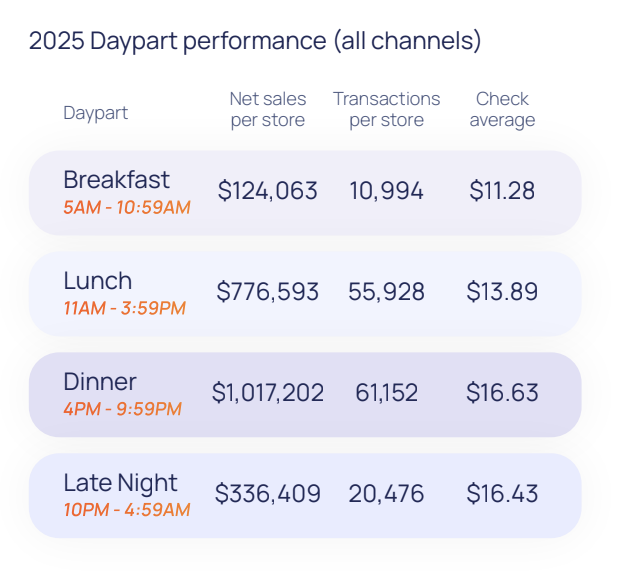
Dinner and late-night are revenue drivers for brands, according to the report. Dinner generates $1.02M per store annually. That's more than breakfast and lunch combined, but most operators don't treat it like that, Yetter said.
“They staff it like a shoulder period and wonder why the numbers don't move. The dinner window runs from 4 to 10pm. Adding your best crew, running a targeted promo, building a delivery-specific bundle for that occasion — those decisions compound because the volume is there. The small bets after 4 p.m. pay out more than most operators realize, because most operators aren't making them.”
The gap between top and bottom performers is operational, not structural with a $1.91 check gap, but the data actually shows that the top 10 percent have built their operations on connected technology.
“The brands at the bottom often have access to the same data,” said Yetter. “The difference is that their systems are disconnected, so they're always reacting instead of anticipating. It's a fixable infrastructure problem for multi-unit operations, but only if operators stop treating front-of-house and back-of-house technology as separate decisions.”