All Aboard for Adaptive Reuse
3 Min Read By MRM Staff
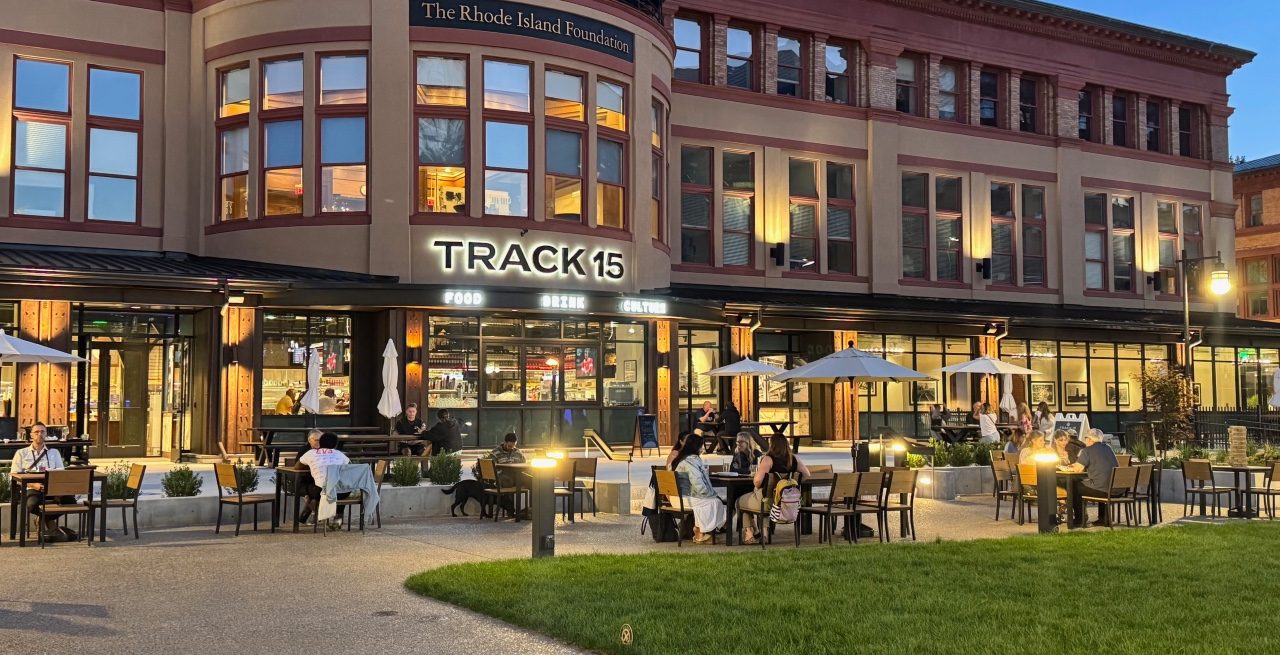
The opening of Track 15 Food Hall last March not only introduced a culinary destination inside Union Station, but also marked the adaptive reuse and revival of the 125-year-old landmark. Led by Marsella Development Corporation, Vision 3 Architects, and CM&B, the the $25-million project is already delivering on its goal to reinvigorate the center of the city.
"What had become a dead zone since 2018 has been brought back to life with over 300,000 visitors since opening in March," said Christopher Marsella, President of Marsella Development Corporation. "People of all ages and all types have been flocking to the area – particularly families with young children. Whether it’s a Friday night music series, a Christmas market or events around the World Cup this summer, it has been a thrill to help activate different types of programming that drive traffic to the center of our beautiful city. It’s not just about the food and drink at Track 15, it’s about the culture."
When selecting the dining mix, the team partnered with Convivium Hospitality Group. Marsella said they wanted to find out who was doing what and where those talents were around specific types of cuisine. They also needed to feel out personalities and see who would work well with others in such a small and collaborative environment.
“We ate our way through Rhode Island for about 18 months before having our first real meeting with any of the chefs about coming to Track 15. With only seven stalls, it wasn't possible to bring in every great chef or represent all types of cuisines, but we think we were successful at finding a great cross section of some of the best talent across Rhode Island.”
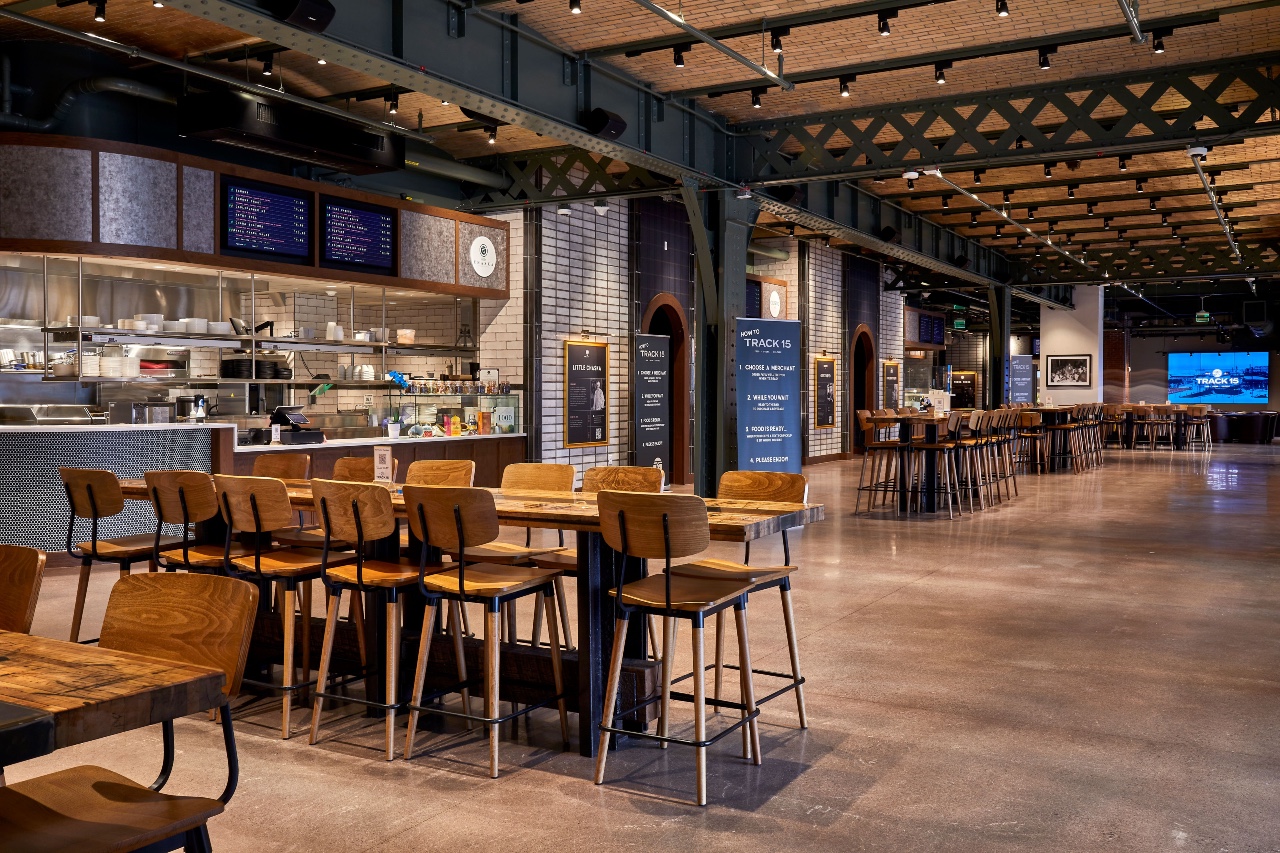
The 18,000-square-foot space is home to seven food vendors – Dune Brothers, Dolores, There There, Giusto PVD, Mother Pizzeria PVD, Little Chaska, and Tolia as well as Artisan Sips Coffee Cart, from Artisan Bites. A large central bar features beer, wine, and spirits from around the world as well as local producers, including a custom gin and vodka label from ISCO in Providence and wines on tap from Sakonnet Vineyard. A 10,000 square-foot plaza with outdoor seating and a home for special events debuted in the summer.
The overall design pays homage to the building’s history and includes the original exposed brick barrel vaults, steel bridge structures, brick walls and columns, and granite walls. Community tables, sourced from Rail Yard Studios in Nashville, TN feature tabletops made from original boxcar flooring and legs made from steel railroad tracks and ties.
Menu boards are replicas of train station departure boards and artwork throughout the space shows the history of Union Station, the City of Providence, and the State of Rhode Island. Picture frames and mirrors were sourced from Providence Picture Frame as well as Aardvark Antiques in Newport, Rhode Island.
As the food hall was to be built within the lowest level of the three story building, with the two floors above being occupied, they had unique challenges penetrating the various floors for mechanical needs, Marsella explained. They were also dealing with a space with no functioning MEP’s so they had to start from scratch with design engineering on all fronts. The private endeavor was supported by two state programs: the Rebuild RI tax credit program as well as the state’s Historic Tax Credit program which were critical to filling financing gaps, Marsella said.
“The real surprise was discovering the building was structurally compromised. If not for some selective demolition for aesthetic reasons alone, we would never have found out the building was in danger of collapse.”
Marsella said they were “beyond honored” to have received one of the state’s highest preservation honors: a 2025 Rhody Award for Historic Preservation from Preserve Rhode Island.
“We did our best to honor the building, the era and to make the food hall feel like it could have always been there. The award is a testament to that achievement, and we are grateful to Preserve Rhode Island for recognizing our efforts.”
Built in 1898, Union Station once served as the transportation hub of southeastern New England before closing in 1986.