The Bundle That Wins Lunch Won’t Win the Afternoon Snack
3 Min Read By Richard Delvallée
Bundles are one of the most effective ways restaurants can communicate value without touching price. Done well, they give guests an easy-to-understand offer while helping operators package the right combination of food, convenience and occasion, which is especially important in an environment where consumers are more price-sensitive.
Consumers do not define value the same way every time they visit a restaurant. The opportunity is to understand what guests actually value in that moment, then build offers around it.
A bundle can combine several parts of the value equation into one clear proposition: an accessible price, convenience, choice, enough food to feel satisfied and a combination that makes sense for the occasion.
Revenue Management Solutions (RMS) recently surveyed 926 U.S. consumers about their restaurant behavior across six dayparts: breakfast, morning snack, lunch, afternoon snack, dinner and late night. “Value” ranked among consumers’ top three priorities at every one of them.
But value was the No. 1 priority only at lunch and dinner.
“Convenience” led at breakfast, morning snack and late night, and it tied with value during the afternoon snack occasion. Dinner was the only daypart where “experience” ranked among consumers’ top three priorities. “Indulgence” showed up only at the two snack occasions and late night, but never at breakfast, lunch or dinner.
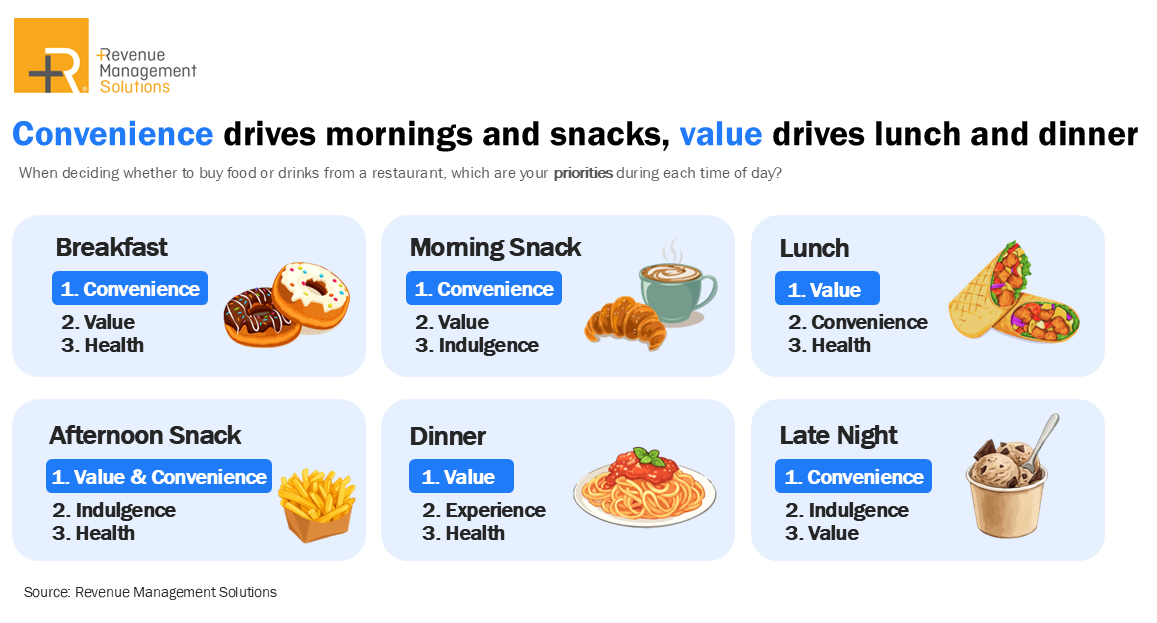
In other words, price matters throughout the day. But what makes an offer feel worth the price changes depending on when and why the consumer is buying.
At lunch, a complete meal bundled into one price may be exactly what the guest needs. In the morning, shaving time off the visit may matter as much as shaving dollars off the check. At 3 p.m., the offer may need to feel like a convenient reward or indulgence.
The same price strategy will not necessarily win all three occasions.
Snacking offers a useful example. In the RMS research, 40 percent of consumers said restaurant snacking costs too much, making cost the No. 1 barrier to the occasion.
But the research also shows that morning and afternoon snack decisions frequently begin with a beverage, while convenience is a leading priority at both occasions. For an operator, the stronger solution may be a clearly priced drink-plus-one bundle available through drive-thru, mobile pickup or grab-and-go. That offer is solving for price, convenience and occasion at the same time.
The afternoon snack adds a second layer. Guests are not only refueling: 14 percent call the visit a break or reward at work, and 15 percent specifically want something sweet. A bundle that pairs the cold drink guests already buy with a salty snack or shareable item and positions it as a treat rather than a discount can convert more of that occasion than a price cut ever will.
This is also why broad discounting can become problematic.
Price sensitivity varies considerably by guest. In the same RMS study, 45 percent of households earning less than $50,000/yr said cost prevents them from buying restaurant snacks. Among households earning more than $100,000, that figure fell to 27 percent.
A blanket offer can therefore underprice a customer who would willingly pay more while still failing to convert a more price-sensitive guest.
The broader lesson is that value needs to become more precise. Elasticity and willingness to pay vary by item, channel, customer and occasion. Operators need to understand where pricing is still most important and where price may not be the real friction point at all.
Getting there requires a more deliberate value architecture that uses consumer behavior, pricing data and menu economics together. That means deciding which customers need an entry-level offer, which occasions call for a bundle, where premium options can still command a higher check and when convenience or experience matters more than another dollar off.
The place to start is small. Pick one daypart that’s underperforming, check whether the current offer is actually solving for what guests say they want, such as convenience, value or indulgence. Then rebuild the bundle around that, not around just price.