Corporate Dining: The Revenue Opportunity Most Restaurants Are Overlooking
5 Min Read By Catherine Sedgewick
How corporate dining is being reinvented in 2026 — and what it means for the restaurant industry.
The corporate cafeteria is facing an existential reckoning. As employees return to offices in greater numbers, the institutions built to feed them are losing ground to a more flexible, restaurant-powered model that better reflects how, when, and where people actually work today.
The Numbers Behind the Decline
More than half of organizations (51 percent) have already reduced cafeteria operating hours, according to ezCater's 2026 Workplace Cafeteria Report, which surveyed 602 cafeteria decision-makers and 1,000 on-site employees.. Operating costs for many now exceed $1 million annually, and 55 percent of decision-makers expect those costs to rise further in 2026.
Most pointedly, 36 percent of decision-makers say corporate cafeterias should be decommissioned in favor of alternative food solutions — a figure that has jumped 39 percent from the previous year. Three out of four (75 percent) say the traditional cafeteria model cannot continue as it is.
There is also a quality gap. Among workers with access to an on-site cafeteria, 38 percent say they don't order what they want because they know it will take too long. Speed, choice, and quality — the three things employees want most — are the three things legacy cafeteria models are often least equipped to deliver. Fewer than half of employees (48 percent) with access to an on-site cafeteria rate the food as good or excellent — a 12 percent decline from the previous year.
Employees haven't abandoned workplace dining — they've simply raised their standards. Successful food programs now meet employees where they are, built around flexibility, rotating menus, local restaurant partnerships, and varied formats that keep the offering fresh, according to the Society for Hospitality and Foodservice Management (SHFM). High-attendance days carry particular weight; the experience on peak in-office days needs to feel deliberate, not default. Beyond the meal itself, SHFM notes that dining has become a moment of connection — balancing convenience with the opportunity to step away from the desk and engage with colleagues. Technology underpins all of it, with mobile ordering, pre-ordering, and frictionless payment now baseline expectations rather than differentiators.
Food as Infrastructure, Not Perk
Despite the collapse of the traditional model, demand for corporate food programs has never been stronger. The shift is not away from feeding employees — it is away from how that feeding gets done. Employees are staying later at the office and increasingly relying on workplace meals to sustain extended in-office collaboration, according to DoorDash's 2026 Workplace Meal Trends Report, which analyzed meal orders from more than 700 companies across 4,800+ offices in AI, tech, banking, pharma, and consulting.
The report concluded that workplace meal benefits have evolved from a simple perk into a strategic tool for driving employee engagement, sustaining productivity, and supporting healthier eating habits. As companies pull back on gym memberships, travel stipends, and other discretionary benefits, food is holding its ground — and in many organizations, growing. Large group orders have seen the highest year-over-year growth during key planning and holiday months, surging in November (+ 33 percent), September (+ 30 percent), and December (+34 percent) as per this report.
What Employees Actually Want
More than half of workers (53 percent) say their company now caters lunch at least once per week, according to CaterCow's 2025 Workplace Food Habits Report. Among employees who already receive regular catering, thirty four percent said they would give up their annual holiday party for free catered lunch every workday; thirty percent would trade away company happy hours; and twenty four percent would forgo their gym or wellness stipend altogether.
Nearly one in five employees said they would sacrifice medical insurance for guaranteed daily lunch at work. Whatever one makes of that trade-off, it speaks to how central food has become to the daily office experience. As SHFM puts it plainly: workplace dining is no longer just about food — it is part of the overall employee experience. The organizations that understand this are pulling ahead of those that still view the cafeteria as a back-office cost center.
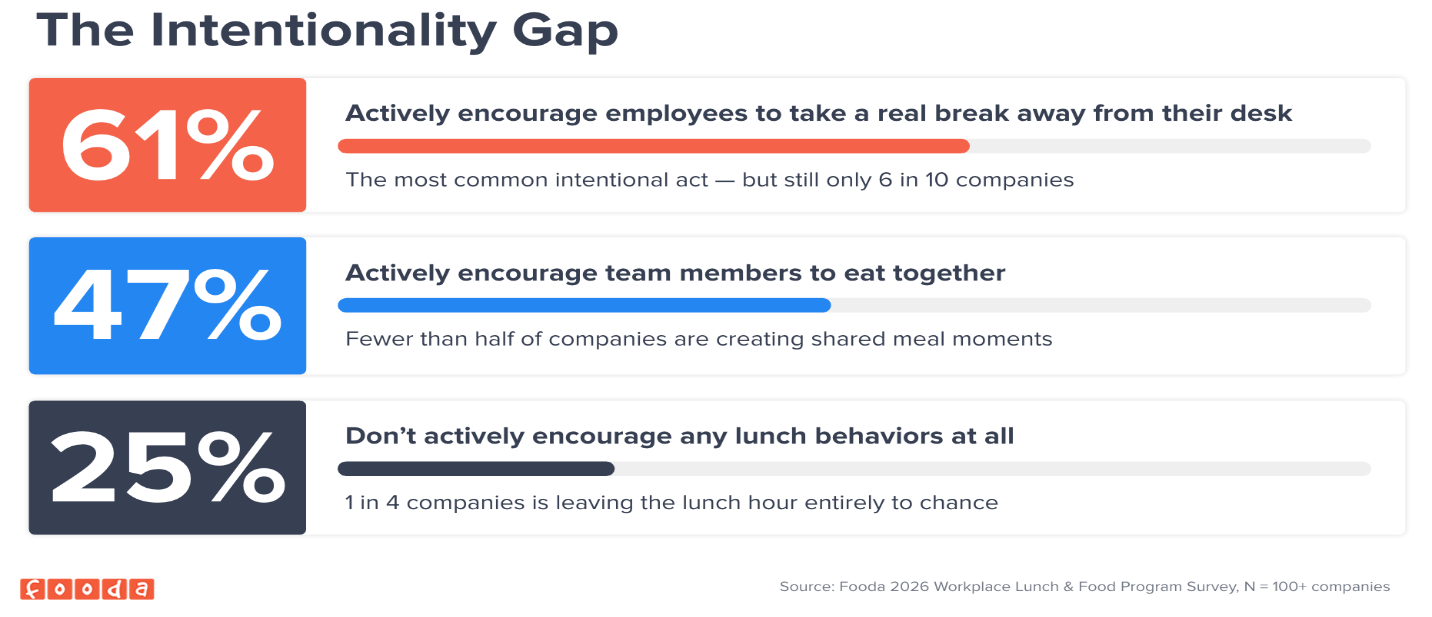
Forward-thinking companies are abandoning the one-size-fits-all cafeteria in favor of four emerging approaches:
- Restaurant-powered meal programs. Among hybrid workplace leaders who oversee an on-site cafeteria, Eighty percent say meals from nearby restaurants would do more to draw employees into the office than their current cafeteria offering. Employees order from a curated selection of nearby restaurants, with centralized invoicing handled by the employer — a model that scales with office attendance, eliminates fixed overhead, and dramatically expands menu variety.
- Flexible catering rotations. Eighty Two percent of cafeteria decision-makers now say flexibility is critical to modern workplace food management, per the ezCater report. Consumer demand is shifting toward flexible meal formats — varying portion sizes and made-to-order options that give people more control over what they eat, when they eat it, and how much they get..
- Dietary Inclusivity. One in six Americans follow a specialized diet — vegan, halal, kosher, gluten-free, and allergy-friendly as per Fooda's 2026 workplace food trends data— and companies that fail to accommodate dietary diversity risk turning a food program from a positive perk into a point of contention, affecting not just excluded employees but overall morale. Forward-thinking organizations are treating dietary inclusivity not as an add-on but as a baseline requirement of any food program.
The Regulatory Layer
The corporate foodservice landscape in 2026 is being reshaped by major interconnected forces —food waste accountability, water quality and hydration infrastructure, and employee wellness as a procurement priority. Layered on top of all these operational shifts is a regulatory push reshaping corporate food procurement. The new packaging and food system policies affecting every restaurant owner like PFAS packaging restrictions, polystyrene bans, and California's SB 54 recycling labeling requirements are forcing procurement teams to overhaul their service ware choices.
AI-driven demand forecasting tools are also being adopted to minimize food waste, a priority both financially and reputationally.
The Opportunity for Restaurants
Food has evolved from a perk to a strategic lever for workplace productivity and culture. Employee meal programs are now core to organizations' strategy to bring employees together. For restaurants, that means predictable, high-frequency demand — and a powerful engine for customer acquisition. — Cindy Klein Roche, Chief Growth Officer, ezCater.
The data points toward a significant and concrete opening for the restaurant industry. The workplace represents a major growth opportunity for restaurants, according to ezCater's 2026 Catering Growth Forum findings, which drew from surveys of over 2,300 workplace food stakeholders and millions of platform transactions. Ninety One percent of workplaces plan to spend the same or more on food in 2026, up from eighty two percent in 2024.
The consumer acquisition angle is also notable. Ninety Six percent of workplaces tried a new restaurant in 2025, and sixty two percent of employees later ordered from those brands in their personal lives — turning the B2B lunch order into a direct consumer acquisition channel according to the same ezCater data. Restaurant brands including Five Guys, Mendocino Farms, and Mission BBQ have joined the ezCater platform in the past year to capitalize on that dynamic.
The corporate dining table is being reset. The restaurants that show up with quality, consistency, and the operational capacity to scale will find it among the most reliable revenue opportunities.