
Failure Is Not Fatal: Lessons on Leadership and Resilience
4 Min Read By MRM Staff
Darryl L. Webb, Sr said he didn’t choose the restaurant industry, it chose him. On his 16th birthday, his mother took him to do two things: get a driver's permit, and fill out job applications at grocery stores, retail stores, and restaurants. The first place that called him for an interview and offered him a job just happened to be Burger King.
“At that point it was a job,” he said. “That job didn’t become a ‘career’ until after moving to McDonald’s Corporation, where they provided me with training, development, and growth opportunities. When I was offered my first very own restaurant as a General Manager, I was so proud, honored, and humbled. It was at that moment that I felt like this was something that I wanted to do for the rest of my life.”
Webb chronicles his story of family, perseverance, faith, and leadership in his new memoir “Who’s On Fries,” blending personal storytelling with practical leadership insights. The former restaurant executive, CEO, franchise owner, and entrepreneur feels his story also serves as a blueprint for leadership under pressure.
“My hope is that people's key takeaway from ‘Who’s On Fries’ is that if I can do it – so can they,” said Webb. “No matter their journey, anything is possible with hard work, focus and determination, making excellence a way of life, treating people with dignity and respect, and always keeping God on your side. I also want them to take away that failure is not fatal, because failure is not final. Get up and keep moving forward!”
Along this journey he has learned and understood that people will always need to eat and whether they ate at your restaurant or category of food establishment, depended on how well you met their needs.
“Taste, price, convenience, value, and overall experience of service (speed and quality) had everything to do with how often they would eat with you.”
Another key lesson learned is that the restaurant industry is a business first.
“You can not survive without both people and profits,” Webb said. “So I learned first how to take care of my people, and second I learned how to make money.”
The pandemic changed “how” people wanted to experience a restaurant, but it did not change the fact that people still want to eat food away from home, he said.
“In the restaurant industry, COVID elevated systems, processes, and routines that we had always been taught – cleanliness and sanitation, and issues around food safety, it brought them to the forefront. The economic impact of COVID also taught me that when people decided they were going to spend their hard earned money with you – you sure better do all you can to earn their dollars and their trust.”
He also learned to strive for excellence in all that he does.
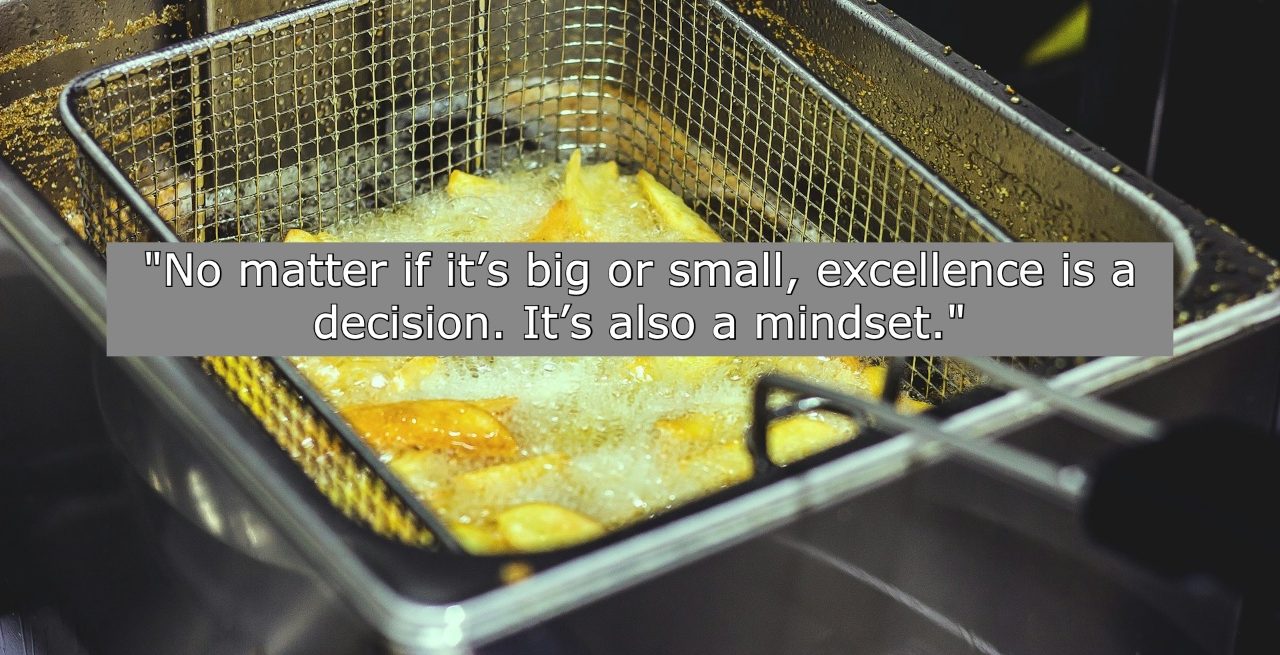
“No matter if it’s big or small, excellence is a decision,” Webb said. “It’s also a mindset. I had to learn not to allow it to paralyze me. It’s not about being perfect – it’s about always striving to do and be your best, and never accepting coming in second.”
Webb’s connection to mentoring is rooted in his personal experience. When he was 17, his first manager, Bill, and later at 22, his director of operations, Claire, recognized a potential in him that he had not yet realized. They dedicated their time to his development, offering support, challenges, and encouragement in ways that no one outside of his family ever had.
“They helped to open doors of possibility and encouraged me to walk through those doors. When I doubted myself, they would not allow me to stay there. I am who I am (professionally) and where I am in large part because of them. Yes, there were many along my journey, but these two stick out the most. So, for me, I owe it to those whose lives that I am privileged to touch to leave the same kind of lasting impression.”
Webb never had any intention of writing a book. He viewed himself as simply "a kid from North St. Louis and University City, MO," who had graduated high school without extensive formal education. His success stemmed from hard work, capitalizing on training and opportunities provided by companies such as McDonald’s, Darden, Bloomin Brands, and Golden Corral, and most importantly, his faith.
As a Pentecostal minister and preacher, his ministry consistently featured "his story"—including the good, the bad, and the ugly. Constant encouragement from people asking where they could buy his book, stating that others needed to hear his journey, finally prompted him to act.
“One day, it finally hit me – I said you’re right I need to capture my journey so that I can bless others.”
While he never had intentions of writing a book, he believed the book was growing inside of him for 15 or 20 years and he knew the title would be “Who’s On Fries” because to him, fries are the key to success.
His first position on his first day of work was making French fries. Throughout his years working at McDonald’s, he would tell his team that within two minutes of walking into one of his restaurants—whether as a manager, district manager, VP, or CEO—he could gauge how well the restaurant was running, or was going to run, by knowing "who was on fries."
"In McDonald’s, fries make the shift, business, customer satisfaction all run. It’s the key! So, my first question most days when walking into a restaurant-and even to this day having sold my restaurants is: 'Who’s On Fries?'."