

The AI SEO Checklist For Restaurants
3 Min Read By Mike Ford
AI search doesn’t follow the old SEO playbook.
It doesn’t pull from your brand’s site, it doesn’t care about your meta tags.
AI pulls from signals across the web.
It doesn’t follow Google’s rules. And that’s the opportunity.
Here’s the twist: if you know what you’re doing, your restaurant can show up in ChatGPT, Gemini, and Perplexity fast. No waiting six months to rank. No backlink begging.
And the payoff? AI clicks convert 4.4 times better than Google clicks, according to SEM Rush.
Here’s how to do it:
1. Write like someone else is recommending you
Large Language Models (LLMs) don’t love your “About Us” page.
They love the blog post that says: Reviewers on multiple sites call (restaurant name) the top-rated spot for authentic, family-style Italian food in the North End. Instead of writing as your brand, write about your brand in the third person.
For example:
- B2C: “Best authentic Thai restaurants in Brooklyn with late-night hours”
- B2B: “Top restaurant reservation systems for minimizing no-shows”
If you don’t write this content, someone else will and they’ll get mentioned by AI.
2. Pick Your Bottom-of-Funnel Prompts
AI assistants are used for decision-stage questions, not “what is” searches.
Think:
-
“Best gluten-free pizza near me for celiacs”
-
“Best happy hour specials in downtown
When people ask AI, they’re not looking for definitions, they’re looking for recommendations, comparisons, and proof points to justify their choice.
Your AI SEO strategy should start with the 10–20 high-intent prompts your customers are already asking.
3. Earn Mentions in Trusted Sources
LLMs lean heavily on domains they recognize as credible and frequently cited. That means you don’t just need great content on your own site, you need to be part of the broader conversation happening on platforms the AI trusts.
Think:
- Review blogs that compare products and services in detail.
- Reddit threads where real users share experiences and recommendations.
- YouTube reviews with hands-on demonstrations.
- Comparison sites that break down features, pros, and cons side-by-side.
- When multiple trusted domains mention your brand, the AI sees a pattern, and that’s how it chooses the brands it mentions.
4. Make it Easy for AI to Choose You
LLMs grab concise, structured info, not fluff. That means your content has to be recommendation-ready from the first line. AI assistants don’t dig for buried details; they surface the clearest, most directly usable answers they can find.
This requires building assets that AI can lift instantly:
- FAQs: Directly answer the exact questions your buyers would type into ChatGPT or Perplexity, using their language.
- Case Studies: Show measurable results with specific data points like conversion rates, ROI, or time saved.
- Pricing Pages: Transparent, easy-to-scan pricing builds trust and removes buying friction.
- Comparisons: ‘X vs. Y’ content signals to AI who you compete with and where you win.
4. Speak Human, Not “Content Marketing”
LLMs don’t reward over-optimized copy, they’re pulling from places where humans actually talk to each other. In those places, the language is direct, authentic, and grounded in real experience.
If you want AI to pick up and repeat your content, it needs to read like it came from a helpful, informed peer. Your tone should make the reader feel like they’re getting advice from someone who’s been there, solved the problem, and knows what actually works.
5. List Yourself Everywhere
Directories are the internet’s original schema. They still matter, especially to LLMs scraping for business info.
Make sure your brand shows up and is filled out in:
- Google Business Profile
- Facebook Business Page
- LinkedIn Company Page
- Trustpilot, Yelp, Tripadvisor
- Local business directories
Yes, it’s tedious. But yes, it’s worth it.
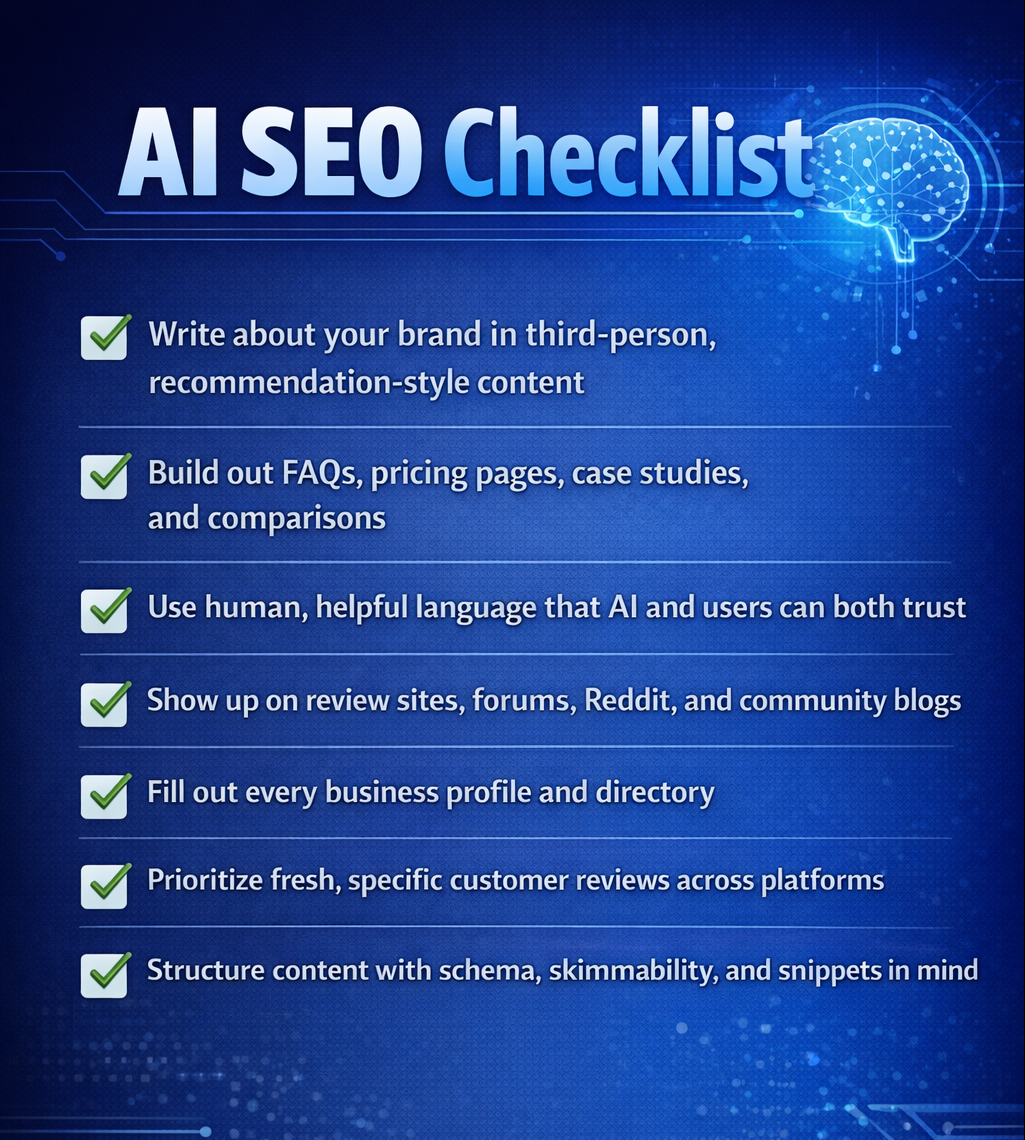
So here’s your AI SEO Checklist:
● Write about your brand in third-person, recommendation-style content
● Build out FAQs, pricing pages, case studies, and comparisons
● Use human, helpful language that AI and users can both trust
● Show up on review sites, forums, Reddit, and community blogs
● Fill out every business profile and directory
● Prioritize fresh, specific customer reviews across platforms
● Structure content with schema, skimmability, and snippets in mind
AI isn’t the future of search. It’s the present.
And the brands who adapt fastest are the ones the AI will talk about.