
Why The Fourth Place Should be Top of Mind for All Restaurants
7 Min Read By MRM Staff
What is The Fourth Place and why is it becoming so important for restaurants?
As online communities and social media platforms shape how people connect and choose where to spend their time, restaurants are evolving into a bridge between the digital world and real-world communities.
The Fourth Place concept is gaining serious traction with dunnhumby’s Retailer Preference Index (RPI) QSR Edition spotlighting its rising importance for brands looking to build relevance and loyalty in a digitally driven era.
To kick off a Modern Restaurant Management (MRM) magazine series on the topic, we spoke with chefs, operators, designers, marketers, and community builders to understand the foundations of The Fourth Place and what operators need to know.
“The modern fourth place as a restaurant goes beyond serving food to serve as a cultural anchor—a space where storytelling, heritage, and human connection converge while using technology to enhance these elements,” explained Chef Carlos Brown, who created Pandora On The Square in McDonough, GA.“We’ve built an atmosphere that is a Gullah-inspired culinary destination where guests return to the Lowcountry, with a feeling of belonging, a communal energy, and immersive, memory-driven experiences.”
Jennifer Brisman, CEO of VOW, said The Fourth Place is something new: the moment when digital communities choose a physical space to come together.
They sit at the intersection of culture, connection and shared identity, which makes them the perfect bridge between online and offline worlds.
“It’s not the old idea of a ‘third place’ like the café or bar where people casually socialize. The Fourth Place is where online identities, fandoms, and highly engaged micro-communities show up in the real world together and restaurants become the natural home base. They sit at the intersection of culture, connection and shared identity, which makes them the perfect bridge between online and offline worlds.”
Karina Tymchenko, Founder of Brandualist, echoes those sentiments.
“This ‘Fourth Place’ is when a restaurant extends a community's digital presence through its physical space. This is essentially a bridge between a user's digital identity and physical gatherings.”
ICUC.social, a global social media and online community management agency owned by Dentsu that provides social listening strategies tailored to brand needs, has been consulting with restaurant and hospitality sector clients including Chili's, Kellogg's, and IHG Hotels & Resorts on how to leverage the trend, according to Nicole van Zanten,Co-President & Chief Growth Officer.
“People form identities and rituals through social platforms, and they can expect those same feelings of belonging when they walk into a physical space,” she said. “When these groups choose a restaurant to meet, they are looking for a space that reflects the interests, rituals, and shared language they have formed online. Restaurants become the backdrop for those digital communities to connect in person. It is really an extension of the world they experience online.”
Fourth places in the QSR industry are gatherings that transform a restaurant’s online presence into real-world experiences, bringing together brand ambassadors—social media foodies, lifestyle influencers, and loyal customers—for curated in-person events that reflect the community built online, added Kevin Jones, VP of QSR and Hospitality at Mood Media.
Online trends are shaping real-world behavior, and it’s only natural that people want to experience them in-person, and connect with others who share their interests and feel part of something larger than themselves.
"Consumers are increasingly seeking experiences, not just products. Restaurant leaders and brands that embrace this shift will stay ahead of evolving expectations, while those that don’t risk falling behind. Online trends are shaping real-world behavior, and it’s only natural that people want to experience them in-person, and connect with others who share their interests and feel part of something larger than themselves."
Justin Gurland, Founder of The Maze, New York City’s first alcohol-free members club and restaurant, believes Fourth-Place thinking will push restaurants to operate less like traditional dining rooms and more like community hubs.
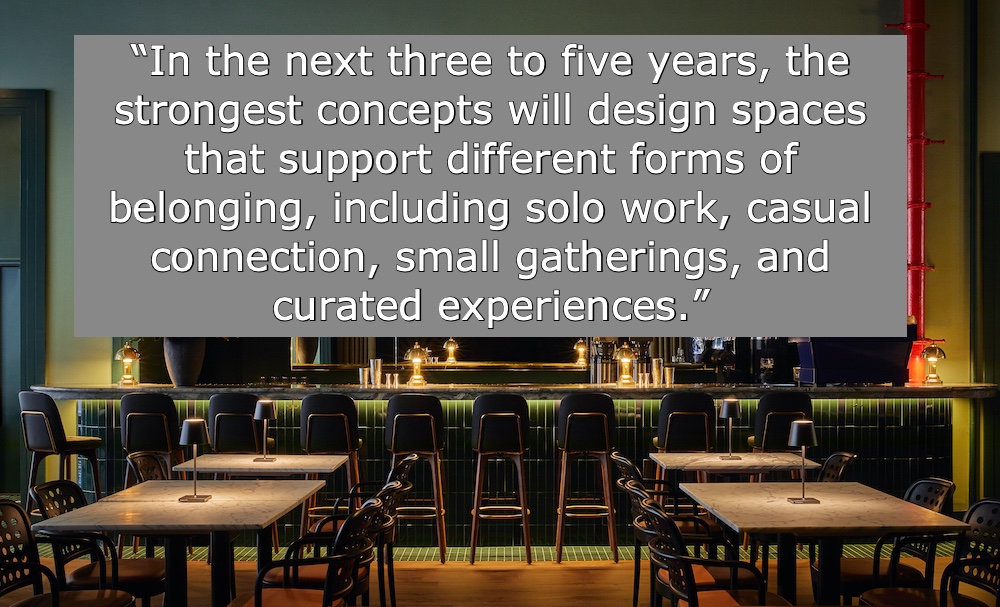
“In the next three to five years, the strongest concepts will design spaces that support different forms of belonging, including solo work, casual connection, small gatherings, and curated experiences.”
Gurland predicts partnerships will shift toward brands and creators that reinforce a restaurant’s identity and values, while loyalty programs will focus less on discounts and more on access, such as early RSVPs, community-driven events, and rewards for showing up and participating.
“We are already seeing this at The Maze. Members use the space throughout the day for coffee, meetings, dinners, and connection driven programming. That blend of utility and community is what fourth place hospitality looks like and where the future of dining is headed.”
David Helbraun, founder and managing partner of Helbraun Levey, a hospitality firm with offices in New York and Florida noted that as guests spend more of their lives in online communities, it is no longer enough to be a good dining room between home and work.
“The next generation of operators will act as community hosts for specific tribes, whether that is an art-driven space like Happy Medium, a gaming cafe, a creator studio, or a neighborhood bar that programs podcast tapings and pop-ups. Over the next three to five years, I expect more hybrid formats that combine food, culture, and membership, with revenue coming from events, collaborations, subscriptions, and brand partnerships layered on top of traditional food and beverage sales.”
Agustina Branz, Senior Marketing Manager at Sourcce86, a global sourcing and private label partner in the food industry, called The Fourth Place a crossover point between online communities and real-world hangouts.
For restaurants, it is really not about food anymore; it's being the place where these communities come to life.
“For restaurants, it is really not about food anymore; it's being the place where these communities come to life. Like with everything else in the market today, people aren't just choosing things without thinking about it. Today, they pick things that are aligned with their values, visuals, aesthetics. If restaurants can tap into that, the experience becomes as important as the food. This creates connection; it goes way deeper than any traditional marketing.”
The Fourth Place is emerging as a setting that prioritizes why people gather rather than simply where they gather, added Courtney Fisher of Ideation Design Group, a Southwest US-based architecture, design, foodservice, and procurement firm.
"Unlike a traditional third place, which offers a neutral hangout outside of home and work, the fourth place is more intentional, building community around shared interests, identities, and experiences. These concepts succeed not by being everything to everyone, but by leaning into specificity: curated spaces, niche programming, menus with meaning, and experiences that attract people who are excited about the same things."
The business model for Zest Maps, an AI-driven dining app that blends personalized food recommendations with real-world meetups by aggregating a user’s dining history, social platforms, friend recs, and reviews to discover spots for shared meals and gatherings, embodies The Fourth Place.
Guests from these communities don’t just walk in from the street — they arrive with digital context like which friends have been or recommended the place on Zest, dishes to get from TikTok reviews, and similar spots from AI tools.
Mario Gomez-Hall's, founder and CEO, said the concept is perfect for restaurants because as online communities connect and move into the real world to meet up and grow closer, they need spaces to do so.
“Connecting over food, sports, or events are the likely winners in the fight for owning this Fourth Place, but the latter two are noisy and the focus of attention is elsewhere. With food, online friends can relax, discover new bonds around taste, and connect in a more intimate setting that still provides an activity to avoid the potential awkwardness that comes from moving from an online chat to an IRL friendship. Guests from these communities don’t just walk in from the street — they arrive with digital context like which friends have been or recommended the place on Zest, dishes to get from TikTok reviews, and similar spots from AI tools."
Peter Newlin, CEO of Gastamo Group, said his group's entire philosophy is built around the idea of a fourth place.
"When I talk about the fourth place, I’m really talking about a restaurant becoming a second home. Traditionally we’ve used three buckets: home as the first place, work as the second, and social spots like cafés or pubs as the third. The fourth place is where those worlds overlap and where people feel a deeper sense of belonging."
He added that in a fourth place, guests aren’t just coming in for a meal; they’re coming in to exhale.
"The space feels residential and lived-in with soft textures, worn-in leather, warm lighting, artwork that looks collected over time, and shelves of objects that feel like they could have come from your own house. It’s a space that’s flexible enough to host a laptop work session at 10 a.m., a family birthday at 6 p.m., and a neighborhood celebration after that. Most importantly, a fourth place is emotionally safe. It’s designed for human connection in an era where people are carrying a lot of stress and experiencing more of life through screens. Our job as operators is to create spaces that restore people, not just serve them."
Fourth places are not about sofas and loitering. They are about creating a restaurant that feels good to choose because it fits who your guests are, how they want to feel, and the community they want to be part of.
It makes sense there’s a lot of talk right now about The Fourth Place as brands are searching for better and more meaningful ways to elevate their businesses and build real loyalty, Rev Cianco, chief marketing officer of Salad House, adding a note of caution.
“I’m not sure we’re thinking about it the right way, though. The second we hear the term, our brains jump to Central Perk from Friends. Cozy couches. Open laptops. Slow-drip vibes. Neighborhood regulars who spend half the day nursing a coffee. That’s cute TV energy. It’s not operational reality.”
He said that most quick-service or fast-casual brands are not optimizing for dwell time.
“You don’t win because people linger. You win because people feel good choosing your restaurant again and again. So instead of rethinking experience, we default back to ‘What’s our next discount?’ because that feels measurable.Here’s the real truth: Fourth places are not about how long people stay. They are about how it feels to be there. Fourth places are not about sofas and loitering. They are about creating a restaurant that feels good to choose because it fits who your guests are, how they want to feel, and the community they want to be part of.”
Top photo courtesy of The Maze.